


Disclosure: one link on this page is an affiliate link. If you buy through it, we may earn a commission at no extra cost to you. It did not affect which tools we list or what we say about them, and the other six links earn us nothing.
Last updated: August 2026 · By Matt Hall
Every roundup of white label software gives you a feature list. Almost none of them give you a price. We checked: of the six independent pages ranking for this term today, only two print a dollar figure anywhere, and only two lay out a comparison table. That is a strange gap, because price is the first thing that decides whether reselling a tool is a business or a hobby.
So this page leads with the number. Every price below was read off the vendor's own pricing page on 16 August 2026, with the plan name written next to it, because the bare figure is misleading on almost every one of these sites. Several of these tools publish four tiers, an annual discount and a stack of per-seat add-ons, and the cheapest number on the page is rarely the one an agency actually pays.
The second thing this page does that the others do not is the arithmetic. Software margin looks enormous on paper. You pay 20 dollars, you charge 300 dollars, you keep the difference. That is true right up until a client asks who is going to build the reports, answer the chat, write the posts and pick up the phone when something breaks. The tool is the cheap part of a white label service. We say so on every entry, and there is a section at the end that puts real numbers on it.
One disclosure up front: we resell some of this category ourselves, and one link below is an affiliate link. It is marked. The other six earn us nothing, and two of the seven tools compete directly with services we sell.
What's in this guide
At a glance
| Theme | Price | Best for | Last updated |
|---|---|---|---|
| GoHighLevel | $497/month for the Agency Pro plan, which is the tier that unlocks reselling the platform itself as your own SaaS. Below it sit Unlimited at $297/month and Starter at $97/month, both of which are for running your own agency rather than reselling seats. Read from gohighlevel.com/pricing on 16 August 2026, list prices, monthly billing. | An agency that wants one branded platform to sell under its own name, and has the client volume to make a 497 dollar floor make sense | Actively trading. Pricing page returned current plans and prices on 16 August 2026, and the plan structure includes recently added AI add-ons, which is a live-development signal rather than a stale page. |
| Vendasta | $0 subscription with a $99/month minimum spend on wholesale products for the Starter plan. Professional requires a $499/month minimum and a one year contract, Premium a $999/month minimum. Each dollar spent on select products discounts the platform fee from month two. Read from vendasta.com/pricing on 16 August 2026, list prices, USD. | An agency that wants a catalogue of white label products to resell without building or staffing any of them | Actively trading. Pricing page returned current plans, current contract terms and a live currency switcher on 16 August 2026. |
| AgencyAnalytics | $20 USD per client per month, billed annually, with all features unlocked and no plan tiers. Add-ons are priced separately: AI search visibility tracking at $20.83/month per 250 credits and extra rank tracking at $41.67/month per 500 keywords, both billed annually. Read from agencyanalytics.com/pricing on 16 August 2026. | Any agency whose clients ask what they are paying for, which is all of them | Actively trading and actively developed. The pricing page on 16 August 2026 listed an AI search visibility add-on covering ChatGPT, Google AI Overview, Google AI Mode and Claude, which is a current-generation feature rather than a legacy one. |
| Landingi | $24/month for Build and $119/month for Optimize, with Scale from $229/month and Enterprise from $1,199/month, all billed annually. Extra domains are $5/month each. Read from landingi.com/pricing on 16 August 2026. Annual billing includes two months free, so monthly billing costs more than these figures. | Campaign work where every client needs their own landing pages on their own domain, fast | Actively trading and actively developed. Current plans, current add-on pricing and recently added AI features were all live on the pricing page on 16 August 2026. |
| SocialPilot | $20/month for Essentials and $40/month for Standard, both billed monthly, dropping to $17 and $34 respectively when billed annually. Extra social accounts are $4/month each. Read from socialpilot.co/pricing on 16 August 2026, USD list prices. | Agencies delivering social media management at volume who need approvals and client reporting without a per seat penalty | Actively trading. Current plans, multi-currency pricing and AI credit allowances were all live on the pricing page on 16 August 2026. |
| Clinked | $239/month for the Standard client portal plan and $599/month for Premium, with a Start Up tier at $11 per user per month and Enterprise on request. A separate virtual data room product is priced from $479/month. Read from clinked.com/pricing on 16 August 2026, monthly billing, with 20 percent off yearly and 35 percent off two yearly advertised. | Agencies whose deliverables are documents and whose clients are large enough to care where those documents live | Actively trading. Pricing page returned current plans, a working per user calculator and current storage allowances on 16 August 2026. |
| WotNot | $29/month for Lite, $99/month for Starter and $299/month for Premium, all billed monthly, with a 20 percent annual discount advertised. Read from wotnot.io/pricing on 16 August 2026. A separate done for you service tier is quoted on request. | Agencies adding lead capture and after hours response to existing clients without hiring for it | Actively trading and actively developed. The pricing page on 16 August 2026 listed recently added features including current LLM model support and an AI agent builder. |
1. GoHighLevel
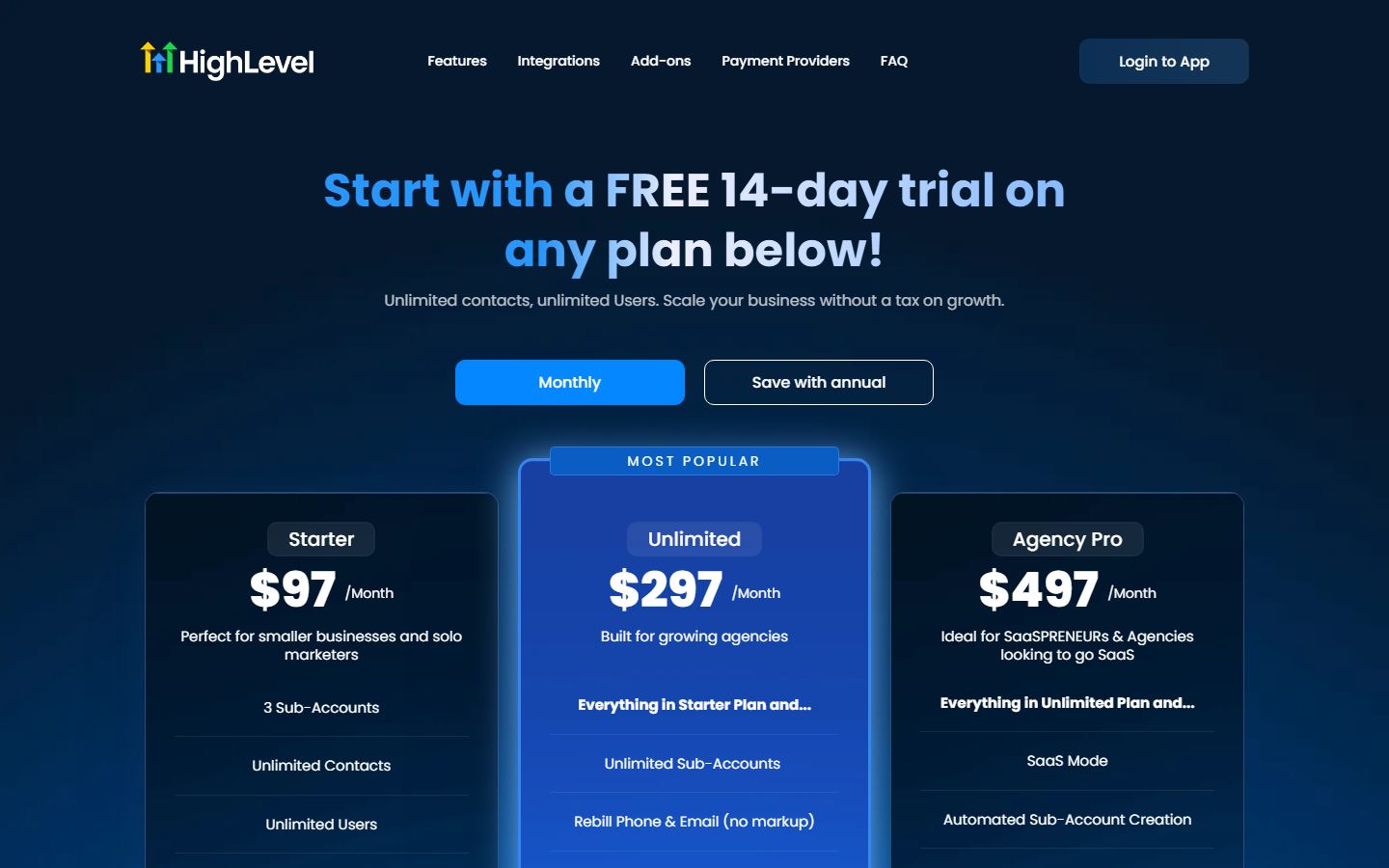
GoHighLevel is the tool most agencies mean when they say they want to sell white label software. It bundles a CRM, pipelines, email and SMS, calendars, funnels, forms, reputation management and automation into one platform, and on the Agency Pro plan you can put your own name and domain on all of it and sell sub-accounts to clients as your own product. That is a genuinely different proposition from reselling a single tool, and it is why the platform has the mindshare it does.
The pricing is where agencies get caught, so it is worth being precise. Starter at 97 dollars a month gives you three sub-accounts and is for running your own shop. Unlimited at 297 dollars a month removes the sub-account cap and is still fundamentally you using the software. Agency Pro at 497 dollars a month is the one that matters here, because it is the tier that turns the platform into something you sell rather than something you use. If your plan is to resell, the honest entry price is 497 a month, not 97.
Then there are the add-ons, and they are per sub-account rather than per agency, which changes the maths as you grow. A branded client portal app is 49 dollars a month per sub-account. Listings management is 30 dollars a month per sub-account. The AI features run 50 to 97 dollars a month per sub-account depending on plan. Ten clients on a branded portal is 490 dollars a month on top of your 497, and that is before anyone has done any work. None of this is hidden, but it is spread across the page in a way that makes the platform look cheaper than it is at scale.
What you get for the money is real. The rebilling system lets you mark up the underlying phone and email usage, so the platform can generate margin on consumption as well as on subscription. The snapshot system lets you build a client setup once and clone it, which is the single biggest lever on delivery cost in this category. If you are going to sell the same package to thirty roofers, a snapshot is the difference between thirty builds and one build plus thirty deployments.
The catch is that GoHighLevel is a platform, not a service, and clients do not buy platforms. They buy outcomes. An agency that sells sub-accounts without also selling the setup, the campaigns and the ongoing management tends to discover that clients log in twice, do nothing, and churn in month three. The platform is the delivery mechanism for a service you still have to design and staff, whether you hire for it or use a white label SEO fulfillment partner. Budget for that before you budget for the software.
If you want the platform side set up for you, our GoHighLevel account setup service builds the CRM, pipelines, and automations.
Price: $497/month for the Agency Pro plan, which is the tier that unlocks reselling the platform itself as your own SaaS. Below it sit Unlimited at $297/month and Starter at $97/month, both of which are for running your own agency rather than reselling seats. Read from gohighlevel.com/pricing on 16 August 2026, list prices, monthly billing.
Maintained: Actively trading. Pricing page returned current plans and prices on 16 August 2026, and the plan structure includes recently added AI add-ons, which is a live-development signal rather than a stale page.
Best for: An agency that wants one branded platform to sell under its own name, and has the client volume to make a 497 dollar floor make sense
Pros
- One platform covers CRM, email, SMS, funnels, calendars and automation, so you are not stitching six vendors together
- Agency Pro lets you resell the platform itself under your own brand and domain
- Snapshots let you build a client configuration once and clone it, which is the biggest single lever on delivery cost
- Rebilling on phone and email usage generates margin on consumption, not just subscription
Cons
- The real resell tier is 497 dollars a month, not the 97 dollar figure most people quote
- Add-ons are priced per sub-account, so the cost curve steepens as you add clients rather than flattening
- It is a platform, not a service, and clients who are handed a login without a service attached tend to churn quickly
- The breadth means every individual module is decent rather than best in class
2. Vendasta
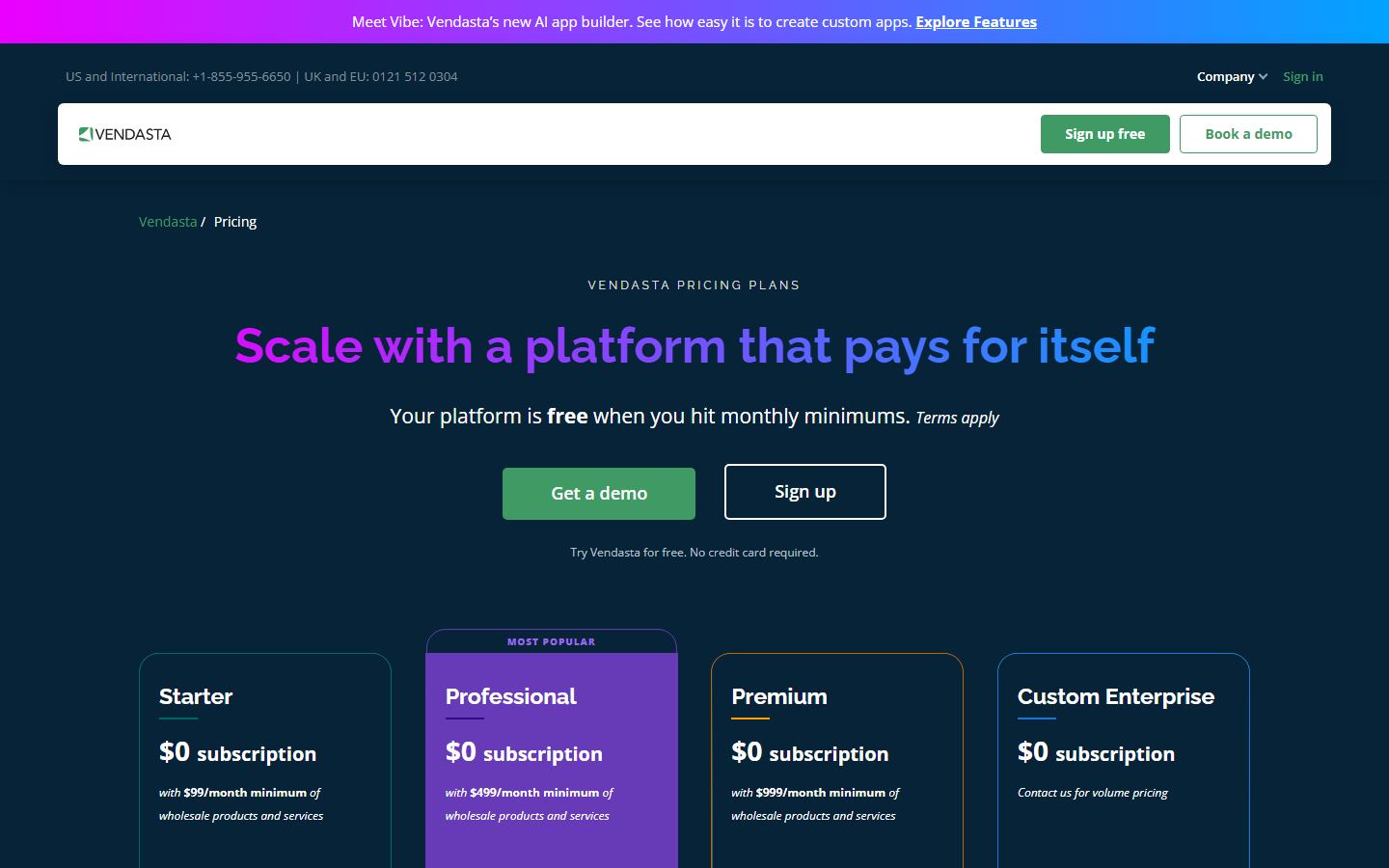
Vendasta is the closest thing this category has to a wholesale marketplace. Rather than selling you one tool to rebrand, it gives you a catalogue of products and services, all white label, that you resell to local businesses under your own name at whatever markup you choose. Listings management, reputation, social, website, advertising and a set of done-for-you fulfillment services all sit in the same storefront, and the client sees your brand throughout.
The pricing model is unusual enough to explain carefully, because it is not a subscription in the normal sense. The Starter plan has a zero dollar subscription with a 99 dollar per month minimum spend on wholesale products. Professional has a zero dollar subscription with a 499 dollar minimum and a one year contract. Premium sits at a 999 dollar minimum. At signing you pay the platform fee, which covers your first month, and from month two every dollar you spend on qualifying wholesale products reduces that fee. In practice the platform is close to free if you are actually reselling, and expensive if you sign up and do nothing.
That structure tells you exactly who it is for. If you have clients today and want to widen what you sell them next month, the maths works, because your fee is offset by spend you were going to make anyway. If you are hoping to sign up, learn the platform and find clients later, you are paying a minimum every month for the privilege of learning. The one year contract on Professional makes that worse, and it is the single thing to read carefully before signing.
The genuine advantage is the fulfillment catalogue. Vendasta will sell you the service as well as the software, which means an agency of one can credibly offer listings management, review responses and content without hiring anyone. That is the same trade this page keeps returning to: software alone leaves you with a delivery problem, and Vendasta is one of the few vendors that sells you the answer to it in the same checkout.
The trade is margin and control. Wholesale fulfillment costs real money, so your margin is thinner than doing the work in house, and the quality is whatever the vendor's team produces that month. You are also building your client relationships on a platform that owns the delivery, which is fine until you want to move. Read the exit terms with the same attention as the entry ones.
Price: $0 subscription with a $99/month minimum spend on wholesale products for the Starter plan. Professional requires a $499/month minimum and a one year contract, Premium a $999/month minimum. Each dollar spent on select products discounts the platform fee from month two. Read from vendasta.com/pricing on 16 August 2026, list prices, USD.
Maintained: Actively trading. Pricing page returned current plans, current contract terms and a live currency switcher on 16 August 2026.
Best for: An agency that wants a catalogue of white label products to resell without building or staffing any of them
Pros
- A whole catalogue to resell rather than a single tool, all under your brand
- Wholesale fulfillment services are available alongside the software, which solves the delivery problem the rest of this list leaves open
- The platform fee is offset dollar for dollar by qualifying wholesale spend, so an agency that actually resells pays little for the platform
- Local business categories are well covered, which fits the classic small agency client list
Cons
- The minimum spend is a real floor: 99 dollars a month on Starter even in a month you sell nothing
- Professional carries a one year contract, which is the term most likely to be regretted
- Outsourced fulfillment means thinner margin and less control over quality than doing the work yourself
- The pricing model takes genuine reading to understand, which is itself a small warning sign
3. AgencyAnalytics
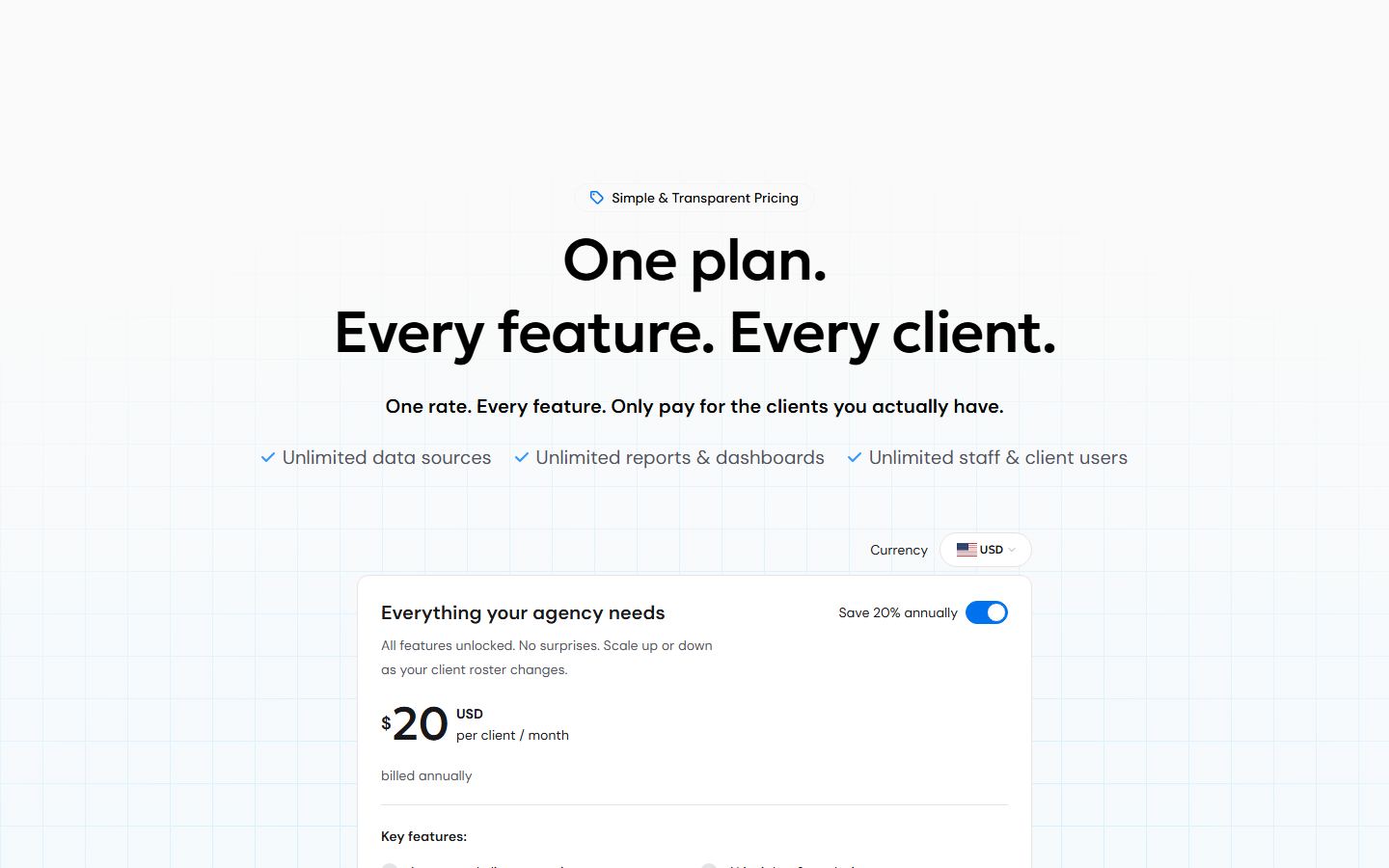
Client reporting is the least glamorous thing an agency does and the most reliable cause of churn when it is done badly. AgencyAnalytics exists to make that problem go away: it pulls data from the platforms you already use, puts it in a dashboard with your logo on your domain, and emails a scheduled report so the client sees progress without having to ask for it.
The pricing is the cleanest on this list, which is worth saying plainly because most of this category is not clean. It is 20 dollars per client per month billed annually, every feature unlocked, no tier ladder to climb and no feature held hostage on a higher plan. You scale up or down as your client roster changes. For an agency with ten clients that is 200 dollars a month, and you can predict next year's bill without a spreadsheet.
The add-ons are where to pay attention, because the base price does not include everything an SEO client will expect. Rank tracking beyond the included allowance runs 41.67 dollars a month per 500 keywords billed annually, and the AI search visibility tracker, which monitors mentions and citations across ChatGPT, Google AI Overview, Google AI Mode and Claude, is 20.83 dollars a month per 250 credits. Neither is unreasonable, but an agency budgeting 20 dollars a client and then adding keyword tracking for all of them will find the real figure is closer to 30.
The white labelling is thorough in the way that matters: your logo, your domain, your colours, and reports that arrive from your address. The client never sees the vendor. That is the entire point of buying this rather than sending screenshots, and it is the difference between looking like an agency and looking like a freelancer with a spreadsheet.
The honest limitation is that a dashboard is not a report. It shows numbers; it does not explain them, and a client who receives a beautiful automated dashboard with no commentary will still ask what it means. The agencies that get value here use the tool to remove the assembly work and spend the saved hour writing three sentences of interpretation. The ones that treat the automated email as the deliverable churn at the same rate they did before, just with nicer charts.
Price: $20 USD per client per month, billed annually, with all features unlocked and no plan tiers. Add-ons are priced separately: AI search visibility tracking at $20.83/month per 250 credits and extra rank tracking at $41.67/month per 500 keywords, both billed annually. Read from agencyanalytics.com/pricing on 16 August 2026.
Maintained: Actively trading and actively developed. The pricing page on 16 August 2026 listed an AI search visibility add-on covering ChatGPT, Google AI Overview, Google AI Mode and Claude, which is a current-generation feature rather than a legacy one.
Best for: Any agency whose clients ask what they are paying for, which is all of them
Pros
- Flat 20 dollars per client per month with every feature unlocked and no tier ladder
- Scales with the client roster, so a lost client is a smaller bill next month rather than a stranded annual plan
- Thorough white labelling: your logo, your domain, your colours, reports sent from your address
- The AI search visibility add-on tracks citations across ChatGPT, Google AI Overview, AI Mode and Claude, which most reporting tools do not yet cover
Cons
- The advertised price is billed annually; monthly billing costs more
- Rank tracking and AI visibility are chargeable add-ons, so the real per-client cost is usually above 20 dollars
- A dashboard is not analysis, and clients still want a human sentence about what changed
- Priced per client, so a large roster of very small accounts gets expensive relative to their fees
See the AgencyAnalytics demo · Get AgencyAnalytics on AgencyAnalytics
4. Landingi
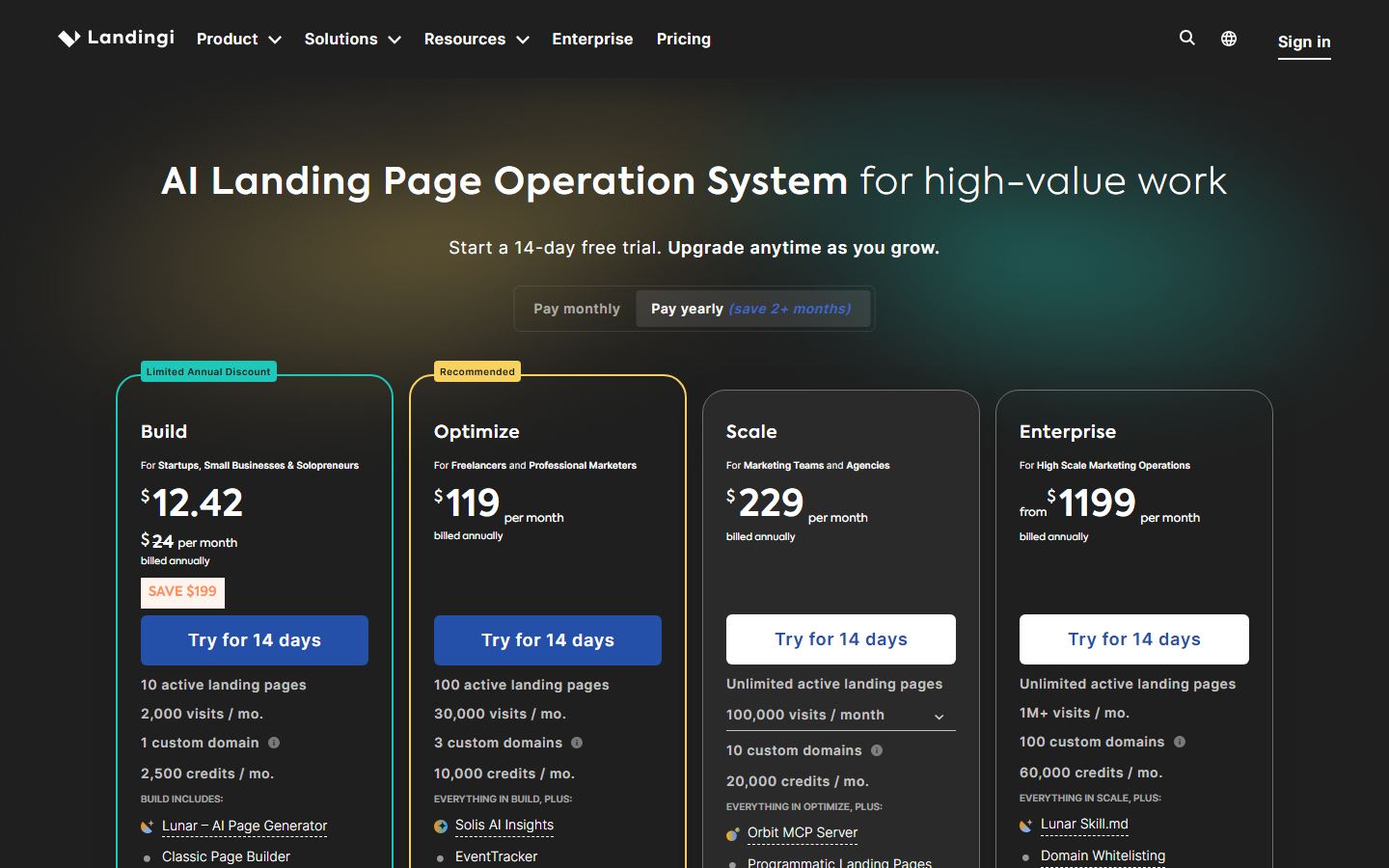
Landing pages are the highest leverage thing an agency builds and the most tedious to maintain. Landingi is a builder aimed squarely at people producing pages for other people: multiple custom domains, a template library, A/B testing and enough client separation that you are not rebuilding the same layout for the fourth roofer this quarter.
The pricing ladder rewards reading. Build at 24 dollars a month billed annually gives you ten active landing pages, 2,000 visits a month and one custom domain. Optimize at 119 dollars a month raises that to 100 pages, 30,000 visits and three domains. Scale starts at 229 dollars a month, and Enterprise from 1,199. Extra domains are five dollars a month each on every plan. All of those figures assume annual billing, which includes two months free, so the monthly commitment costs meaningfully more.
For agency use the domain count is usually the binding constraint rather than the page count, and this is the detail most people miss when comparing. One client generally means one custom domain. On Build you get one domain, so a second client already means either five dollars a month more or a jump to Optimize. Ten clients on Optimize means three included domains plus seven at five dollars, which is 154 dollars a month all in. That is still reasonable, but it is not the 24 dollars on the front of the pricing page.
The white labelling is adequate rather than complete. Pages publish on the client's own domain, which is the part that matters and which the client actually sees, and the editing experience carries the vendor's branding. For most agencies that is the right trade, because clients look at published pages and rarely at the builder. If your model is handing clients a login to edit their own pages, look more carefully at what they will see.
The limitation worth stating is that a landing page builder is a production tool, not a strategy. It removes the hours between deciding what to test and having something live, which is real value, but it will not tell you what to test. Agencies that buy it to go faster get their money back quickly. Agencies that buy it hoping the templates contain the answer generally do not.
Price: $24/month for Build and $119/month for Optimize, with Scale from $229/month and Enterprise from $1,199/month, all billed annually. Extra domains are $5/month each. Read from landingi.com/pricing on 16 August 2026. Annual billing includes two months free, so monthly billing costs more than these figures.
Maintained: Actively trading and actively developed. Current plans, current add-on pricing and recently added AI features were all live on the pricing page on 16 August 2026.
Best for: Campaign work where every client needs their own landing pages on their own domain, fast
Pros
- Priced from 24 dollars a month, the lowest entry point of anything on this list
- Multiple custom domains, so client pages publish under the client's own brand
- A/B testing and a template library remove most of the repetitive production work
- Extra domains are five dollars a month, so scaling client by client is cheap and predictable
Cons
- The headline prices are annual billing; monthly costs more
- Domain count rather than page count is the real constraint for agency use, and it forces plan upgrades sooner than expected
- The builder interface carries vendor branding, so it is not fully white label if clients log in
- Visit caps matter on campaign work, and exceeding them means an upgrade mid-campaign
5. SocialPilot
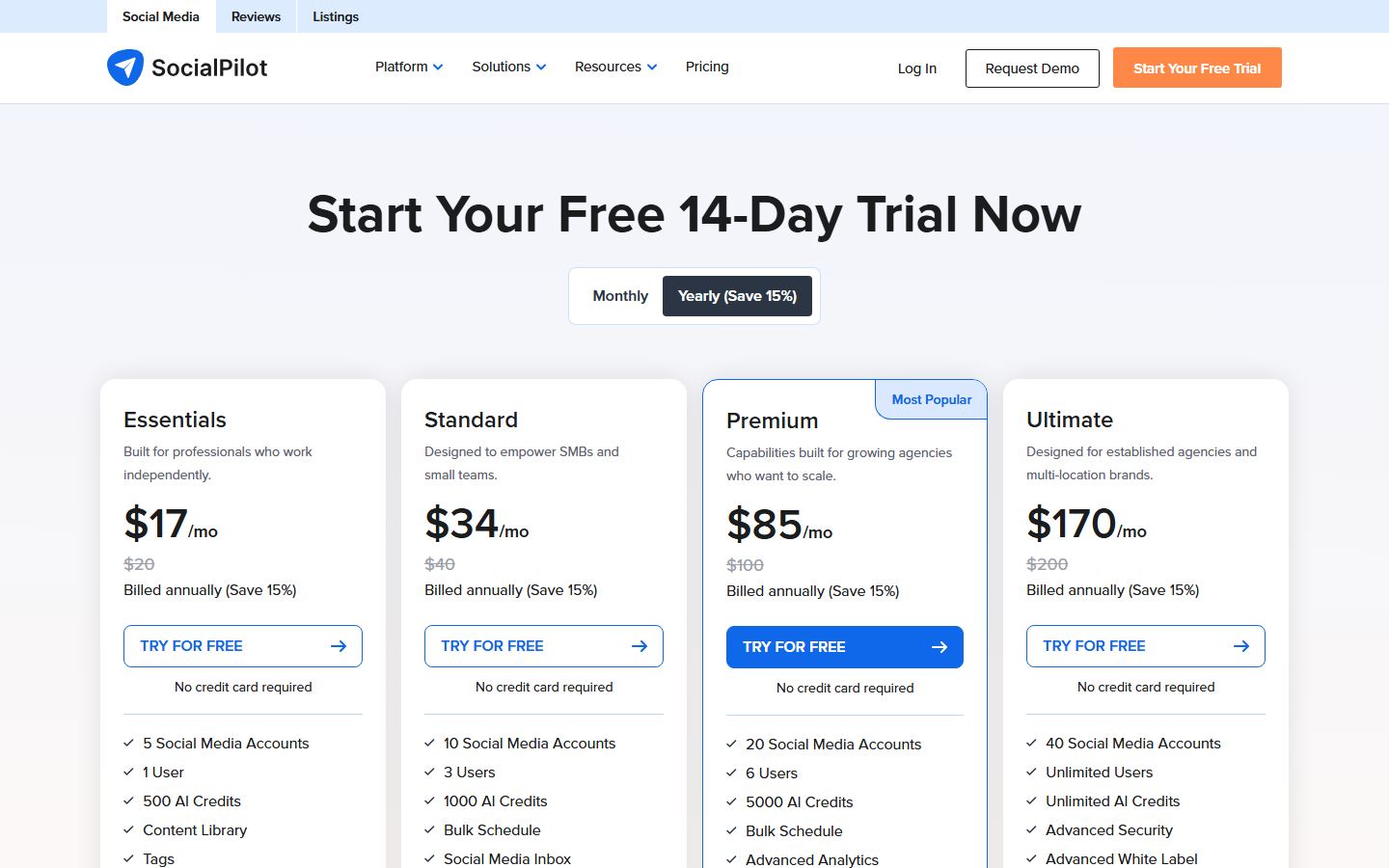
Social media management is the service most often sold on thin margin, so the tooling cost matters more here than anywhere else on this list. SocialPilot is built for people running accounts on behalf of others: bulk scheduling, a content library, client approval workflows and white label reporting, priced for agencies rather than for brands.
Essentials is 20 dollars a month billed monthly, or 17 billed annually, and covers five social accounts and one user with 500 AI credits. Standard is 40 dollars a month, or 34 annually, and is aimed at small teams. Extra social accounts are four dollars a month each. Those figures were read from the pricing page on 16 August 2026 and the vendor also lists euro, pound and Australian dollar pricing, which is worth checking if you are billing outside the United States, because the converted figures are not always what you would expect.
The account maths is what decides whether this is cheap. A single client with Facebook, Instagram, LinkedIn, X and a Google Business Profile is five accounts, which is the entire Essentials allowance. Two clients is ten accounts, so Essentials plus five extra accounts at four dollars each is 40 dollars a month, at which point Standard is the same money with more headroom. Work the number out against your actual client mix before picking a plan, because the per account add-on quietly doubles the bill at exactly the point most agencies start.
The client approval workflow is the feature that earns its keep and the one to test first. Social work generates more review cycles than any other retained service, and the difference between approvals inside the tool and approvals over email is measured in hours a week. The white label reporting is solid without being remarkable, which is fine given the price.
The limitation is scope. This publishes, schedules, approves and reports. It does not write anything worth reading, and social is the service where clients most reliably confuse activity with results. The tool removes the logistics of posting. It does not remove the need for someone who knows what to post, and that person is your entire cost base on this service line.
Price: $20/month for Essentials and $40/month for Standard, both billed monthly, dropping to $17 and $34 respectively when billed annually. Extra social accounts are $4/month each. Read from socialpilot.co/pricing on 16 August 2026, USD list prices.
Maintained: Actively trading. Current plans, multi-currency pricing and AI credit allowances were all live on the pricing page on 16 August 2026.
Best for: Agencies delivering social media management at volume who need approvals and client reporting without a per seat penalty
Pros
- Agency oriented pricing that does not punish you per seat the way brand tools do
- Client approval workflows cut the review cycle that makes social work unprofitable
- Extra social accounts are four dollars a month, so growth is incremental rather than a cliff
- White label reporting is included rather than an upsell
Cons
- Five accounts is one realistic client, so the entry plan covers less than it appears to
- Per account add-ons accumulate quickly and often make the next plan up the better buy
- AI credits are capped per plan and are consumed faster than most people expect
- It handles distribution, not content, and content is the actual cost of a social retainer
6. Clinked
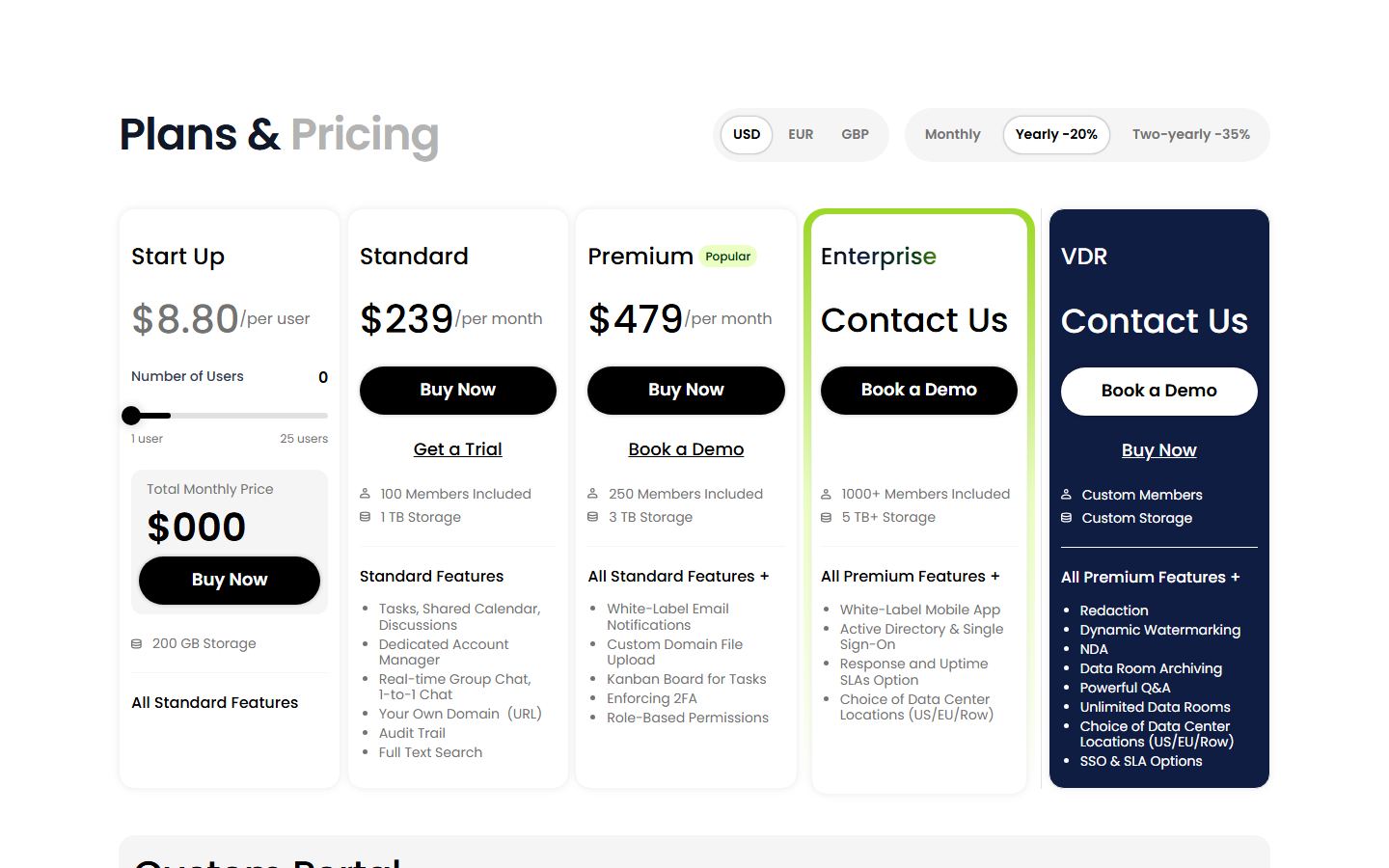
Clinked is a white label client portal, and it is the most expensive tool on this list by a wide margin, so it needs justifying. It gives each client a branded space on your own domain holding files, tasks, discussions and approvals, with an audit trail over the lot. If your agency delivers documents to clients who care about governance, that combination is worth real money.
Standard is 239 dollars a month and includes 100 members and a terabyte of storage. Premium is 599 dollars a month with 250 members and three terabytes, and adds the features most agencies would actually want: your own domain, full text search, group chat and the audit trail. There is a Start Up tier at 11 dollars per user per month for very small teams, and a separate virtual data room product from 479 dollars a month. Yearly billing takes 20 percent off and two yearly takes 35 percent, which is a meaningful discount on numbers this size.
The thing to notice is that your own domain sits on the Premium tier. For a white label tool that is the feature, so the honest entry price for an agency buying this to look like its own software is 599 dollars a month rather than 239. That is more than a junior contractor's monthly retainer, and it should be judged against what the portal actually wins you rather than against the other tools on this page.
It wins two things. The first is positioning: an agency with a branded portal, an audit trail and document versioning looks like a firm rather than a freelancer, and that closes larger clients. The second is fewer lost hours, because the alternative is email threads, and the cost of finding the approved version of a deliverable in an email thread is real even though nobody measures it.
The limitation is that a portal is only worth what your clients put into it. Small local clients will not log in, and a 599 dollar a month portal that three roofers ignore is the most expensive way to store files ever devised. This is a tool for agencies moving upmarket, serving clients with compliance requirements or multiple stakeholders. If your client base is single owner local businesses, buy something else and spend the difference on delivery.
Price: $239/month for the Standard client portal plan and $599/month for Premium, with a Start Up tier at $11 per user per month and Enterprise on request. A separate virtual data room product is priced from $479/month. Read from clinked.com/pricing on 16 August 2026, monthly billing, with 20 percent off yearly and 35 percent off two yearly advertised.
Maintained: Actively trading. Pricing page returned current plans, a working per user calculator and current storage allowances on 16 August 2026.
Best for: Agencies whose deliverables are documents and whose clients are large enough to care where those documents live
Pros
- Genuinely white label: your domain, your branding, on the Premium tier
- Audit trail, versioning and full text search, which matter for regulated or multi stakeholder clients
- One place for files, tasks, chat and approvals rather than four
- Yearly and two yearly billing cut the price by 20 and 35 percent, which is substantial at this level
Cons
- The most expensive tool here, and your own domain requires the 599 dollar Premium tier
- Small local clients frequently will not use a portal at all, which makes the spend dead weight
- Overlaps with a client portal you may already have inside an all in one platform
- Member counts rather than client counts drive the plan, which is awkward for many small clients
7. WotNot
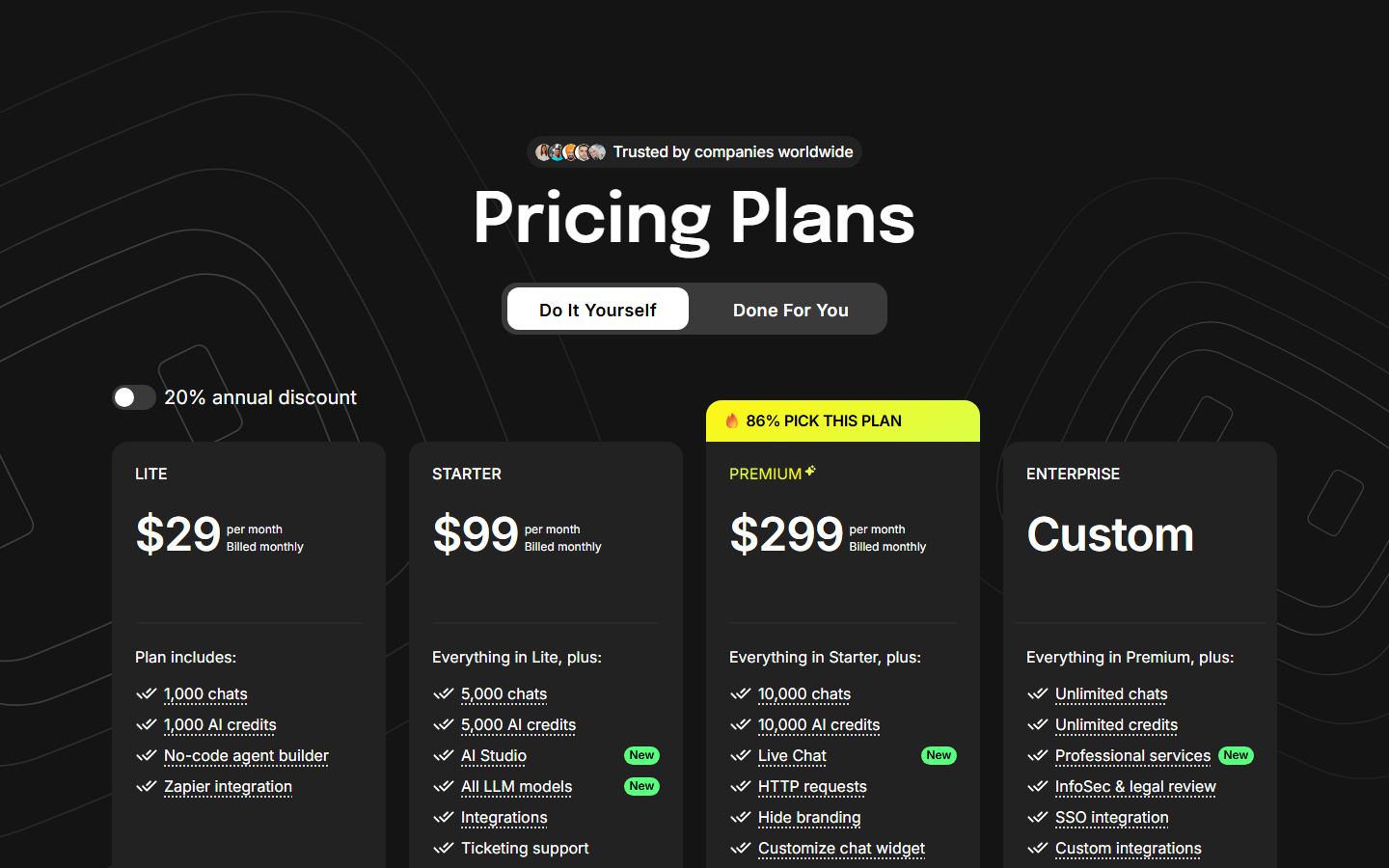
Chat is the easiest additional service to sell to an existing client, because the pitch needs no explanation: someone visited your site at nine in the evening, nobody answered, and they went to a competitor. WotNot is a no code chatbot and AI agent builder with white label options, priced low enough that an agency can bundle it rather than sell it separately.
Lite is 29 dollars a month and includes 1,000 chats and 1,000 AI credits with the no code builder. Starter is 99 dollars a month for 5,000 chats and adds the AI studio. Premium is 299 dollars a month for 10,000 chats and adds current LLM model support, integrations and ticketing. There is a 20 percent annual discount and a separate done for you tier quoted on request, which is worth asking about if you would rather not build the flows yourself.
The chat allowance is the number to watch, and it is easy to misjudge in the wrong direction. A thousand chats a month sounds generous until you remember that a chat is any conversation, including the ones where someone types a single word and leaves. On a site with real traffic the Lite plan can be consumed by noise, and the jump from 29 to 99 dollars is where the economics of bundling this into a retainer either work or do not. Model it on one client's actual traffic before promising it to twenty.
The strength here is the AI agent builder rather than the old decision tree chatbot. A scripted bot that cannot answer a question that was not anticipated annoys people and reflects on your client, whereas an agent grounded in the client's own content answers most of what is asked and hands over cleanly when it cannot. That is now the baseline expectation, and it is priced accessibly enough that an agency can include it in a package rather than making it a separate line item.
The limitation is that chatbots are the single easiest thing to deploy badly. A bot that intercepts a customer trying to reach a human is worse than no bot, and clients blame you rather than the software. Budget time for the handover design, not just the build, and check what happens after hours when nobody is there to take the escalation. That work is the service; the 29 dollars is not.
Price: $29/month for Lite, $99/month for Starter and $299/month for Premium, all billed monthly, with a 20 percent annual discount advertised. Read from wotnot.io/pricing on 16 August 2026. A separate done for you service tier is quoted on request.
Maintained: Actively trading and actively developed. The pricing page on 16 August 2026 listed recently added features including current LLM model support and an AI agent builder.
Best for: Agencies adding lead capture and after hours response to existing clients without hiring for it
Pros
- Starts at 29 dollars a month, cheap enough to bundle into an existing retainer rather than sell separately
- AI agent builder grounded in the client's own content rather than a rigid decision tree
- White label options so the widget carries the client's brand and not the vendor's
- A done for you build tier exists for agencies that would rather not configure flows
Cons
- Chat allowances are consumed by low quality conversations, so the entry plan covers less traffic than it appears to
- The jump from Lite to Starter more than triples the price at 99 dollars a month
- A badly designed handover to a human makes the client's service worse, and they will blame you
- Advertised prices are monthly; the 20 percent discount requires an annual commitment
How to choose
Start with the tier that actually lets you resell, not the one on the front of the pricing page. This is the single most common costing error in this category. GoHighLevel is quoted at 97 dollars a month and the reselling tier is 497. Clinked is quoted at 239 and your own domain arrives at 599. Landingi is quoted at 24 and a second client needs a second domain. Every vendor advertises the number that gets you in the door, which is rarely the number you will pay, so find the feature you specifically need for white labelling and read the price next to that.
Work out the cost per client, not the cost per month. Most of these tools are priced per client, per social account, per domain or per sub account, which means the bill grows with your roster rather than sitting flat. Take your actual client list, count the domains, accounts and seats it implies, and calculate the real monthly figure at that size. An agency with ten clients pays substantially more than the pricing page suggests on almost every tool here, and the ones that scale gracefully are worth a premium for that alone.
Check annual versus monthly before you compare anything. AgencyAnalytics, Landingi and SocialPilot all advertise annual pricing by default, and Clinked discounts 20 percent yearly and 35 percent two yearly. Comparing one vendor's annual price against another's monthly price makes a 30 percent difference appear out of nowhere. Put every tool on the same billing basis before deciding.
Decide whether you are selling software or selling a service, and price accordingly. Reselling a 20 dollar tool for 300 dollars looks like a 280 dollar margin and is not, because the client is buying an outcome that requires someone to produce it. The tools on this page remove production work. None of them remove the person. If your plan has no line for delivery labour, the plan has no margin in it, it just has not found out yet. How agencies structure that spread is its own subject, covered in our guide to white label pricing models.
Prefer tools that publish their prices. Two of the six independent pages ranking for this term print no prices at all, and several vendors in this category hide pricing behind a demo call. A vendor unwilling to publish a number before speaking to you is a vendor whose price depends on what they think you can pay, which is a poor foundation for a service you intend to resell at a fixed rate.
Test the exit before you commit. The 12 month contract on Vendasta's Professional tier and the annual commitments elsewhere are the terms most likely to be regretted, because the tool that fits ten clients often does not fit forty. Check what happens to your client data and your client relationships if you leave, and prefer month to month while you are still learning what you are selling.
FAQ
What is white label software?
White label software is a product built by one company and sold by another under its own name. The company that made it stays invisible: the logo, the domain, the emails and the interface all carry the reseller's brand, and the end client believes they are buying from the reseller. For an agency it means offering a dashboard, a portal or a platform as your own product without building or maintaining any of it.
Can you give me an example of white label software?
Every tool on this page is one. A concrete example: AgencyAnalytics builds the reporting platform, your agency puts its logo on it and serves it from your own domain, and your client receives a monthly report that appears to come from you. The client never encounters the vendor's name. The same pattern applies to a GoHighLevel sub account sold as your platform, or a Clinked portal sitting on your domain.
Is white labeling illegal?
No. White labelling is a normal commercial arrangement and the vendors on this page actively sell it, with reseller and agency tiers built for exactly this purpose. What matters is staying inside the licence you bought: rebranding a product whose terms permit rebranding is legitimate, while removing a vendor's branding from a plan that does not include white labelling is a breach of contract. Read what your tier permits, and do not claim you built software you licensed.
Can I buy a white label app?
Yes, and there are two routes. You can license an existing platform on a tier that permits rebranding, which is what GoHighLevel's Agency Pro plan and Clinked's Premium tier do, and be selling within days. Or you can commission a custom build, which costs more and takes months but leaves you owning the product. For almost every agency the first route is correct, because the value you add is the service around the software rather than the software itself.
What does white label software actually cost an agency?
More than the advertised price, and the gap is consistent enough to plan around. Across the seven tools here the entry prices run from 24 to 599 dollars a month, but the tier that permits genuine white labelling is often several times the headline figure, and most of these vendors charge per client, per domain or per social account on top. A realistic small agency stack of reporting, landing pages and social for ten clients lands in the high hundreds per month before anybody has done any work.
Is reselling software the same as white label fulfillment?
No, and confusing them is the most expensive mistake in this category. Reselling software gives your client a login. White label fulfillment gives your client the work: the campaigns built, the reports interpreted, the posts written, the chats answered. Clients pay retainers for outcomes, not for access. Software reduces the cost of producing outcomes, which is worth a great deal, but a login sold as a service churns in about three months. The distinction is drawn out further in our answers to the common white label questions.
Which white label tool should an agency buy first?
Reporting, in almost every case. It is the cheapest tool here per client, it addresses the most common cause of churn, which is a client who cannot see what they are paying for, and it requires no new service line to justify it. Landing pages come next if you run campaigns, and an all in one platform only makes sense once you have enough clients to absorb a several hundred dollar monthly floor.
Can Scepter help us package and fulfill white label services?
Yes. White label fulfillment is one of the things we do: we deliver SEO, content and campaign work under partner agencies' brands, which means the agency keeps the client relationship and we stay invisible. If you are weighing whether to buy tools, hire, or partner for delivery, that is a conversation worth having before you commit to an annual contract. Our white label SEO services for agencies page sets out how the partnership works, and you can tell us what you are trying to package if you would rather talk it through.


