


By Matt Hall, Founder, Scepter Marketing
Scepter Marketing does Pleasant Ridge MI web design for small businesses, and every site we build is meant to produce calls. In a city this compact, odds are most of your buyers live past the city line. A site that only says "Pleasant Ridge" misses them. We build yours to be found, and picked, across the towns your work reaches.
Each one opens fast on a phone, looks as established as your work, and puts your number one tap away for a buyer who has never met you.
Short version: we build websites for Pleasant Ridge businesses whose customers are spread across Oakland County, and we judge each build by the calls and form requests it produces, not by how it photographs.
Pleasant Ridge, at 0.57 square miles, is the fifth-smallest city in Michigan by land area. That size shapes the job your website has to do. A business here rarely lives on walk-in neighbors. Its buyers are in the cities around it, often searching on a phone, with no idea who you are. Your site is the first thing they see, and often the only thing they check before picking someone.
Pages for the towns you actually serve give buyers outside Pleasant Ridge a reason to pick up the phone.
Real photos of finished jobs and a current design tell a stranger you're established, long before you speak.
Clean structure and town-specific pages help Google match you to searches made across Oakland County, not just inside your few blocks.
The leaks are rarely obvious from the owner's chair. You open your homepage on office Wi-Fi and it looks fine. A buyer two cities over opens it on a phone in a parking lot, waits, and backs out. Or the service they need is buried three menus deep. Or the form still sends to an email address nobody checks anymore. None of those buyers tells you they left. They simply call the next listing. We test for each of these, on real phones, and close them before anything else.
A drag-and-drop builder is a reasonable way to get a brand-new business online, and for a one-person consultancy run from a home office it can carry you for a while. Trouble shows up later. Pages get heavier as you add them. The design looks like thousands of others. Adding a page for a second town turns into an afternoon of fighting the editor. That's usually when owners start shopping for a rebuild.
We think the math favors building it once. A site on clean code stays quick as it grows, takes a new service page or town page without a redesign, and shouldn't need replacing in two years. We'd rather you pay for one build than two, even if that one costs more up front.
Picture a renovation contractor working from a house in the historic district west of Woodward. The work is good and the referrals are steady. But in a city this small, nearly every job sits in a neighboring city like Huntington Woods or Royal Oak. The current site names Pleasant Ridge once, in the footer, and has a single page called Services. When a Royal Oak homeowner searches for a remodeler on a phone, nothing on that site matches their town or their project. The fix: a page for each kind of job, a page for each town you truly work in, photos of real finished rooms, and a call button that stays on screen.

Fast to launch and cheap to start. It gets slower and harder to bend as you add services and towns.

Decent on day one. Then edits wait on one person, and the site stalls once they stop answering email.
Recommended

Quick, owned by you, ready for new town pages, and judged by the calls it brings.
The people who design your site are the same people who run SEO and Google Business Profile work, so a Pleasant Ridge site gets built with the surrounding cities in mind from day one. We're Michigan-based, we keep U.S. business hours, and our office is in East Lansing, not Pleasant Ridge.
O1

Nobody hands your site to a separate SEO vendor after launch. The builders already plan pages around how neighboring towns search.
O2

You reach people in Michigan during your own workday, not a support queue running overnight in another country.
O3

A pretty site that never rings your phone is an expensive brochure. We build for the tap, the call and the form.
O4

In one 2026 audit pass on our own site, we restored 167 broken images and cleared 141 redirect problems. Your site gets that scrutiny too.
O1

The free AI Visibility Check runs on our own audit engine, the same one we use on real prospect audits.
Scepter is run by Matt Hall, our founder. Matt's been doing this work since about 2009.

Founder at Scepter Marketing
Six steps, in order: plan, design, build lean, wire up the leads, prepare for search, launch. You can skip ahead if part of the work already exists. For a Pleasant Ridge firm the planning step matters most, since that's where we decide which neighboring towns get their own pages.

We start with a call about your work, the jobs you want more of, and the towns they come from. You bring photos and a rough service list.

That turns into a written plan: the pages, the order we build them, which towns earn a page of their own, and the one step each visitor should take next.
01
02

We lay out pages around your real projects and your brand, then walk you through the mockup. Nothing moves to code until you sign off.

The homepage, the main service pages and the contact page come first, since a stranger from a nearby city is most likely to land on one of them. Each one is tested on a small phone screen before we move on.

Light pages that open quickly on any phone and stay simple for you to edit.

We size images properly, drop scripts the site doesn't use, and keep plugins to a minimum. A homeowner on a weak signal still sees your work instead of a spinning wheel.
03
04

Forms that arrive, a number that dials with one tap, and a record of where each lead started.

We send test submissions through every form and confirm they land with you. On phones, your number becomes a button. Tracking records the page each lead came from, so you can see whether the town pages are pulling their weight.

Titles, headings and page structure set up so Google and AI assistants can parse them.

Every page gets a title and heading that name the service and the town it covers, plus schema markup and quick load times. If you add SEO with us later, that work begins on pages already built correctly.
05
06

Full testing before go-live, then edits, fixes and new town pages when you need them.
Before go-live we click every link and submit every form on phones and laptops. Afterward we stay on hand for updates, so a new service or a new town page doesn't sit in a queue.
Each item below exists for one reason: helping a buyer who lives outside Pleasant Ridge find you, believe you, and reach you. Nothing decorative, nothing you can't edit.
What we do
Homepage, service pages and contact page drawn up around your brand and photos of your own jobs, instead of a stock theme you'd find on countless other sites.
Why it works
A stranger decides fast whether you look real. Pages that clearly belong to your business keep them scrolling toward your number.
Where it shows up
A first-time visitor from a neighboring city sees work that matches your reputation, and feels safe enough to reach out.
What we do
Hand-built pages on clean code, without a heavy theme stacked with add-ons, so speed holds now and three years from now.
Why it works
Slow pages bleed visitors and make ranking harder. A lean build keeps load times low as your page count climbs.
Where it shows up
Pages that open quickly, visitors who stick around, and speed that survives growth.
What we do
Correct titles, headings, internal links and schema, plus quick loading and a page structure Google and AI assistants can follow without guessing.
Why it works
Sound technical groundwork gives SEO something to stand on and tends to weather Google's updates better.
Where it shows up
A head start on searches from the neighboring Oakland County cities, with no rebuild required before SEO begins.
What we do
We design for a phone screen first, then widen it for desktops, since that's where many buyers meet you.
Why it works
On a phone, every extra scroll or tiny button costs you. Big tap targets and short pages turn a curious homeowner into a call; a fiddly layout sends them back to the results.
Where it shows up
More phone visitors calling or finishing forms rather than leaving.
What we do
Forms, a click-to-dial number and lead tracking, set up so each inquiry lands with you and shows where it started.
Why it works
A site that quietly drops messages costs more than a site that doesn't exist. Working forms and a number that dials on one tap start real conversations.
Where it shows up
Every call and form reaches you, and you can see which pages produce them.
What we do
A short walkthrough so you can handle routine edits, with us on call for bigger changes.
Why it works
When editing is easy, your services, hours and project photos stay current without a support ticket.
Where it shows up
A site you keep fresh on your schedule, not ours.
Three things decide it: the page opens fast, it looks trustworthy to a stranger, and the next step is obvious. Run these checks on your own site with a phone in hand.

Fast on a phone.

Credible on sight.

One obvious action.
Speed check: open your homepage on your phone over cellular data and count to three. If it's still loading, you're likely losing people. Trust check: could a stranger from a neighboring city tell, without scrolling, what you do and that you're real? Photos of your own projects and recent reviews answer that. Next-step check: is your number a tappable button on every page, and does your form actually reach you? Send yourself a test. Last, think of the contractor from earlier: search your trade plus the town where most of your jobs are, and see whether any page of yours matches.
Google now puts AI-written summaries above the links on many searches, and some people ask ChatGPT for a recommendation before they search at all. Those tools lean on sites they can read cleanly. A cluttered site gives them little to quote.
The same clean structure helps in ordinary search and in AI answers. Our free AI Visibility Check, which runs on our own audit engine, reports how your Pleasant Ridge business reads to Google and AI assistants right now, and what a rebuild would fix first.
We don't have a Pleasant Ridge client to point to, so here's what we can show instead, with the limits of each spelled out, and what it means for a business whose buyers live in neighboring cities.


Problem
Our own website. One audit wave in 2026 found 167 legacy images broken and 141 redirects misbehaving, the slow decay owners rarely spot until visitors do.
The Plan
We fixed all of them in that one pass. It's the same unglamorous technical cleanup we'd run on your site before and after launch.
The Plan
For a Pleasant Ridge owner, the takeaway is simple: broken images and dead links chip away at a stranger's trust, so we go find them.


Problem
A question worth asking of any SEO team: does the listing show up across the map, not just near the office?
The Plan
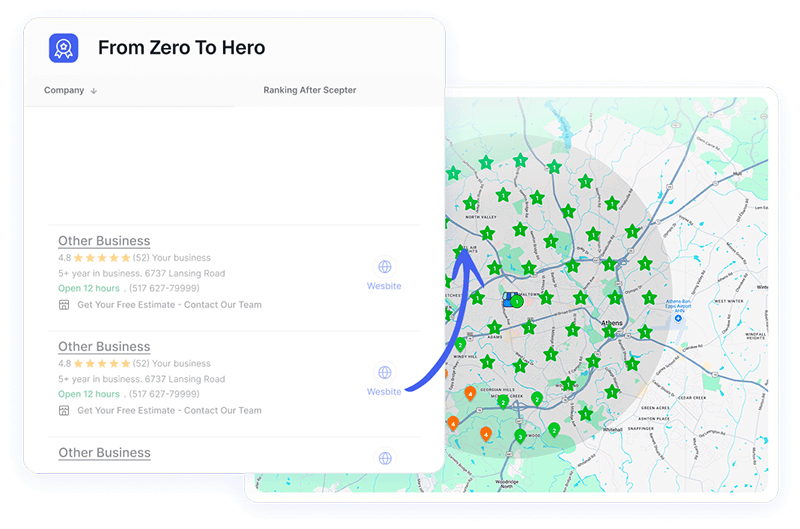
We manage Google Business Profiles for businesses, and our local SEO results page publishes 99 Google Maps grids drawn from 30 of them.
The Plan
Every published grid shows top-three placement on 60% or more of the points searched, and 28 of them hold the top three at every point. Names stay hidden on purpose, and it's a selection. That's the work behind SEO for Pleasant Ridge businesses, which pairs with our web design across Michigan and, if you want ads too, Pleasant Ridge digital marketing.
If your shop sits just over the line, we also handle web design in Ferndale (about a mile away), Huntington Woods websites (also about a mile), and Oak Park web design (about 2 miles).


Problem
What you won't see here: a Pleasant Ridge client. We don't claim one, and nothing on this page should suggest it.
The Plan
Instead, open the published map grids and judge the work with your own eyes.
The Plan
If it holds up, a short call covers your site, your towns and your scope.
Builds from our portfolio, each worth a quick look on your phone. None are Pleasant Ridge businesses. Ask for examples and we'll share the ones closest to your trade.
Product pages for a machine tool brand. Open them and see how fast you reach the specs. A contractor with many service types needs that same clarity.
Open it and judge whether a new section could fit without a redesign. A Woodward Corridor business adding a second service line needs that kind of room.
An urgent care site in Lansing, not here. Time how long it takes to find hours and directions; your own service pages should pass that test.
A site for a business-to-business firm. Judge whether it looks settled and credible from the first screen. A consultant working from a Pleasant Ridge home office faces the same question: do I look real?
Notice how quickly the main product categories appear. Any trade with a long service menu, renovation included, should copy that clarity.
Look at how its sections are organized. If you expect to add town pages over time, a structure with room for new sections is the pattern to look for in any builder's portfolio.
Big buttons, short pages, and the essentials near the top. Open it on your phone, then open yours, and compare how far you scroll.
Clean layout, plain claims, an easy path to an inquiry. Professional services often sell to people comparing several firms at once, and this is the bar a site has to clear.
A catalog with many products only works if it stays current. Ask any web designer whether your own staff will be able to update yours without calling a developer.
Look at the navigation and ask whether it leaves room for new sections. A Pleasant Ridge firm that will someday serve more towns should ask for that planning before the first page.
This fits a Pleasant Ridge business that mostly sells to people in the cities around it, has a site that's slow, dated or silent, and wants pages that produce inquiries. If your site needs a repair, not a rebuild, we'll say that up front.

Why this matters. Owners who show up with photos and a clear goal give us more to build with, and those projects tend to move faster.

Why this matters. A site with a broken form or a cramped mobile layout loses work silently. Saving a little on the build can cost far more in calls that never came.
Straight answers to what Pleasant Ridge owners ask before they commit to a new site.
A fair price is whatever matches your scope, so we quote after a scoping call instead of posting a number. Scope means page count, whether we write the copy, and integrations like booking. In a city this small, the swing factor is usually town pages: covering several neighboring cities well takes more pages than covering one.
The honest answer: as soon as your content is ready, since that sets the pace more than the build does. Revision rounds and any tools we connect also matter. We set target dates together at the start, but we won't promise one before we've seen your photos and copy.
Yes, if you really work in those cities. Pleasant Ridge shares borders with both, so a business here often serves people on the other side of a city line. A page per town, built around real jobs there, helps buyers and Google connect you to their searches. One data point: in six months, this page drew 3 impressions for "ferndale web design", average position 54.
Proof a stranger can see in a few seconds: photos of your own work, recent reviews, a plain list of what you do, your number in view, and pages that load fast on a phone. Buyers from neighboring cities rarely have another way to size you up, so we put those signals on every key page.
Yes. The design, the content and the domain belong to you, and the domain should sit in an account you control. If you ever move on, all of it goes with you. We'd never hold a site or domain hostage to keep a client.
Because the homeowner deciding who to call about an old kitchen is probably holding a phone, not sitting at a desk. Starting with the small screen forces plain layouts, big buttons and light pages. Those choices improve the desktop version too. Shrinking a desktop design down often leaves cramped text and buttons too small to hit.
Google Ads reports no monthly volume for "web design pleasant ridge mi" or its two close variants. In a city this small, we usually suggest pairing a new site with work that helps it surface beyond city limits. The free AI Visibility Check shows where to start.

SEO aimed at the neighboring cities where your jobs actually are, built on the same pages we designed, so nothing gets redone.

We set up a simple way to ask finished customers for Google reviews, so new visitors see current, real feedback.

Paid search can send traffic to the new pages while organic visibility grows.
Too Busy to Dive In?Pressed for time? Enter your address in the free AI Visibility Check. It reports how Google and AI assistants interpret your site, how quickly your pages load, and which single fix should come first.