


By Matt Hall, Founder, Scepter Marketing
Scepter Marketing takes on Pleasant Ridge businesses for digital marketing, and the goal is more phone calls from people close by. Digital marketing in Pleasant Ridge has a geography problem: the whole city is 0.57 square miles, with 2,627 people counted in 2020. So most of your likely callers live next door, in Ferndale, Royal Oak, Oak Park or Huntington Woods.
Our job is putting your listing and site in front of those searchers, a mile or two past your address, and counting every call that comes back.
A Maps listing tends to look strongest close to its own address. For a business in a half-square-mile city, close isn't enough. We measure how far you reach, then work on the distance.
A Huntington Woods homeowner, roughly a mile away, wants a painter for the dining room. Their path runs from a Maps listing to the website to the reviews. If any one of those three looks thin, they back out and call the next name. We treat that chain as a single job and give it one owner.
Your listing has to show up where the searcher stands, which is often outside Pleasant Ridge.
Once they click through, your site should name the service, the towns you cover and how to book.
Recent reviews that describe real work give a stranger a reason to pick you.
Pleasant Ridge ranks fifth-smallest in Michigan by land area, at 0.57 square miles. A contractor or shop based here can't run on 2,627 residents, so most jobs have to come from across the city's borders. Reaching those people takes three things working together. The Maps listing has to rank a mile or two out. The site has to say plainly which neighboring towns you cover. The reviews have to look current to a stranger who has never driven past your door. When three vendors each own one piece, nobody checks whether the listing reaches that far, and the gap stays invisible.
A profile with good photos and a few reviews can win searches made right around it. Push a mile out and it often meets businesses with stronger pages behind them. Without a site that names the service and the towns you cover, Google has little reason to show you there. Ads can fill that gap for a while, but they stop the day the budget does.
When the pieces are managed together, each one patches a gap in the others. Your listing handles searches close to the shop. A service page about the work you do in the neighboring cities lets Google consider you for searches there too. Reviews that describe the actual job help a stranger pick you. Paid clicks come last, and only on terms where organic reach hasn't caught up. Since one team sees every piece, a soft spot gets repaired, not argued about.
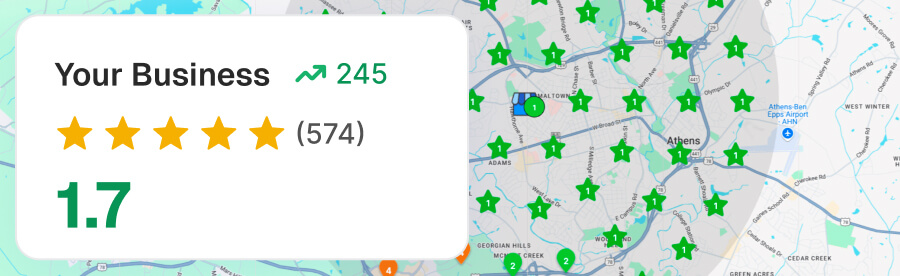
We'd start with a ranking grid. It checks Google Maps from a spread of points around your address and records where you place for one search at each spot. For a business here, the grid has to cover the neighboring cities, because the city alone covers too little ground. Woodward Avenue also splits the city, with the historic district and its spacious homes on the west side and more modest homes on the east. A remodeler may want reach on both sides. The grid shows which points are green and which aren't, and that becomes the plan.

Free to start, but a listing nobody updates and calls nobody counts tell you nothing.

Fine for a single job like a profile cleanup. It breaks down when nobody connects the listing to the site, the reviews and the phone.
Recommended

Listing, site, reviews and tracking handled together, measured on grids and calls, adjusted each month.
Before we pitch, we check where your listing appears, and our grid results sit on a public page. After that, a single Michigan team handles all your channels on U.S. hours, and we fix our own site with the same technical work we sell.
O1

You'll hear what we're running, which towns it's aimed at, and what number we'll watch. If something isn't worth your money, we say it.
O2

We're a Michigan team working normal U.S. business hours. Write during your workday and it reaches us during ours, not a queue on the other side of the world.
O3

We post our Maps grids publicly. Look at how we measure before you sign anything.
O4

One crew handles your listing, pages, reviews and ad spend. When calls slow down, nobody gets to point at another vendor.
O1

Begin with the Maps listing and a few town pages. Add ads or more neighboring cities once the tracking justifies it.
Matt Hall has worked in this field since about 2009. His method: map where a listing shows up and where it doesn't, fix the gaps, then map it again.

Founder at Scepter Marketing
Whether you start with one channel or several, the sequence holds: audit, tracking, launch, adjust, report, expand. Below, each step is walked through for a hypothetical painter or remodeler working out of Pleasant Ridge.

We'd pull a ranking grid on the painter's main service, read the Business Profile line by line, and run the site through our own audit engine for broken pages.

Your written plan lists each gap, the fix for it, and the order we'd work in. A common one: the grid shows green around the storefront and turns red a mile away. Another: a painter whose profile carries one category while the business does three kinds of work.
01
02

Tracked phone numbers and form capture go in before any change, so the starting count is honest.

For the painter, the profile's call button, the website's number and each contact form report separately. That split matters later. If calls rise after new town pages go live, we'll see whether they came from Maps or the site, and we can compare against a real baseline.

Broken pages and a thin profile come first. Then the Business Profile, local SEO pages for the towns you serve, and reviews. Google Ads only if a gap remains.

For the painter, the foundation might mean fixing slow pages and setting a service area that matches reality. Next come pages for the services that bring real jobs, each one naming the towns covered. Review requests go out after finished jobs. If the grid still shows thin reach on one side, a small search campaign covers it while organic work catches up.
03
04

We rerun the grid, read the call log, and move effort toward whatever is producing work.

Say the points on one side of the city turn green while the other side stays red. That tells us where the next page or review push should go, instead of guessing. If calls don't follow, we note that too.

Each month: calls and form entries split by where they started, the latest grid, the cost, and the next change.

Kept short, with no acronym left unexplained. A slow month gets named as slow, along with our read on the cause and the change we're making next. You shouldn't need us on the phone to decode it.
05
06

Once the grid holds steady near home, we extend the same work to the next town you want jobs from.
Expansion means a new page for that town, a wider grid, and review requests from jobs finished there. If tracking shows the new area isn't paying back, we pull effort back to where it was working.
Every item here is aimed at one gap a Pleasant Ridge business can have: a listing that's strong near home and weak a mile or two out. Use this list to compare any agency, us included.
What we do
We set categories, services, service area, photos and posts on your Google Business Profile so it matches the work you do in the neighboring towns.
Why it works
Fixes a profile that only shows up close to its address. A complete, accurate listing gives Google more reasons to show it to searchers a mile or two away.
Where it shows up
Watched on the ranking grid point by point, and in the calls and direction requests the profile logs.
What we do
Every job type and every town you work in gets its own page, and we clear the technical errors that stop Google from reading them.
Why it works
Fixes a site that names one city and one vague service. Pages that name the towns and the work give your listing support farther from home.
Where it shows up
Search Console shows impressions on the new pages, and tracked calls show which pages led to a booked estimate.
What we do
Every source gets its own call-tracking line: the Business Profile, the key pages of your site, each ad. Forms log the URL where a lead filled them out, and call recordings show what callers actually asked.
Why it works
Fixes the guesswork about whether last month's jobs came from Maps, a page, or a neighbor's referral.
Where it shows up
A call log split by source, so effort moves toward what's producing estimates.
What we do
We repair broken pages, images and redirects, then add plain answers to the questions homeowners ask before hiring.
Why it works
Fixes a site that loses the visitor your listing just sent. We fixed 167 broken images and 141 redirect problems in a single 2026 pass on ours.
Where it shows up
Fewer exits after the tap, and more visitors reaching the call button.
What we do
A small search campaign on the services and towns where the grid shows weak reach, with a capped budget and tracked calls.
Why it works
Fixes the stretch when a town still sits outside your organic reach, without paying for searches you already win.
Where it shows up
Cost per call for each campaign, and a clear signal for when we'd suggest turning the ads down.
What we do
One short report: this month's grid, the call log by source, total spend, and the next planned change.
Why it works
Fixes the agency report full of charts that never mention a phone call.
Where it shows up
A few pages you can finish over coffee, with questions answered by the people doing the work.
Google Ads reports no search volume for any of three phrasings built around “pleasant ridge mi digital marketing.” The city's name alone won't carry your marketing. So the job is getting found for your services in the neighboring cities too.

Calls from neighboring towns.

Reviews strangers believe.

Listing, pages, reviews and tracking handled by one team, measured together.
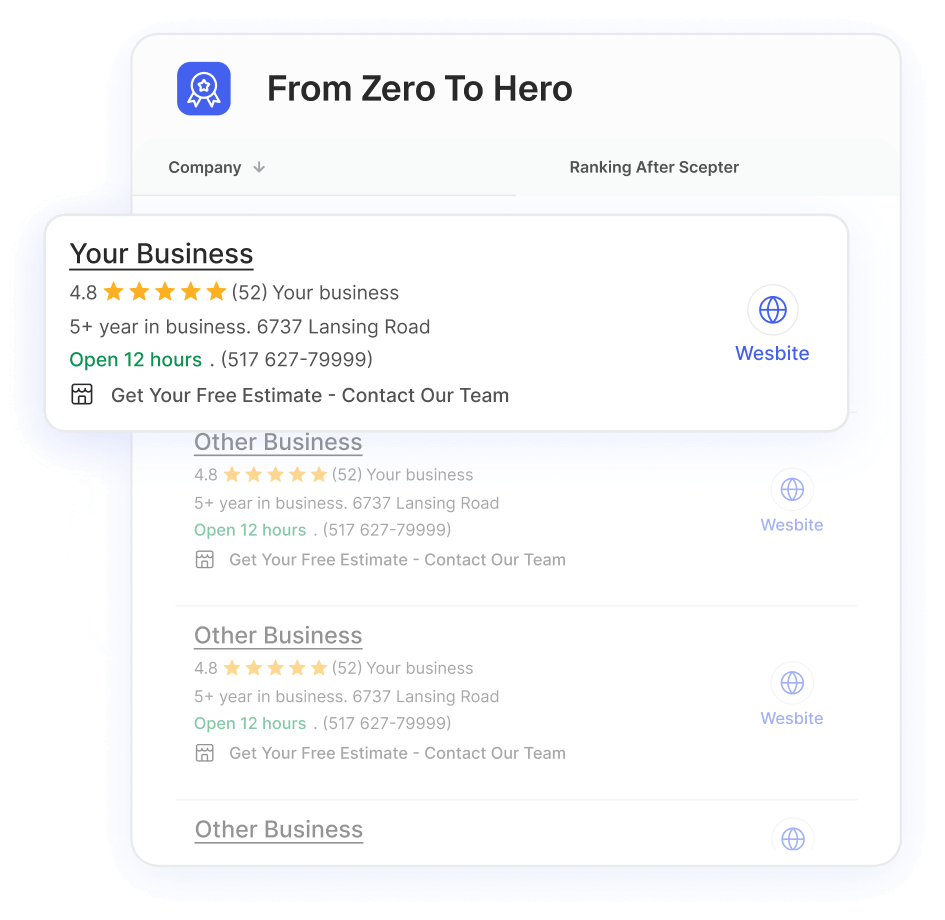
Take a remodeler working out of Pleasant Ridge whose profile ranks well on the blocks closest to the shop, then drops away within a mile or so. In the city's 0.57 square miles, those close blocks hold only a sliver of the homes the remodeler could work on. The fix starts with a grid covering the neighboring cities, not just the address. Then come service pages that name those cities, review requests after each finished job there, and tracked calls showing which part of the map produces estimates.
A homeowner in the historic district might skip Google and ask ChatGPT: “Which painter near Pleasant Ridge, Michigan does careful work on older homes?” The assistant pieces its reply together from what it can read: listings whose details match, reviews that name the actual work, and site pages that spell the job out plainly.
Nobody controls which business an assistant names, so we won't promise you a mention. Our AI Visibility Check costs nothing and runs on the audit engine we built in-house. It reads how Google's AI answers and chat assistants describe you now, and points to the one listing or page we'd repair first.
These examples don't come from Pleasant Ridge. One is a set of Maps grids from listings we manage elsewhere, one is our own website, and the third is the check we'd run for a business here.


Problem
Many owners can't see past their own phone. A search from the shop can look great while nobody checks what a searcher a mile away sees.
The Plan
We check rankings from many points around each Business Profile we manage, then publish a selection.
The Plan
Across 30 profiles, 99 grids each put the business top 3 on at least 60% of points. In 28 of those grids, it's top 3 everywhere searched.


Problem
In 2026 our site needed the cleanup we sell to clients: legacy images that no longer loaded and redirects that misbehaved.
The Plan
We worked through all of it in one audit wave, the same technical pass we'd run on a client's site.
The Plan
Result: 167 broken images restored and 141 redirect problems fixed. The full program is on our Michigan digital marketing page. If ranking is the main goal, start with Pleasant Ridge SEO. If visitors leave your site before calling, our Pleasant Ridge web design work is built for that problem.
Covering more than one town from here? Each nearby city has its own page: Ferndale digital marketing (about 1 mile away), Oak Park, Hazel Park and Royal Oak (each about 2 miles), and Berkley (about 3 miles). Those pages are built around different local problems, so the advice doesn't repeat.


Problem
Grids from other businesses say nothing about yours. The names are blank because agencies resell our SEO to most of those businesses, and we chose which grids to show.
The Plan
So we'd run the same grid method on your listing, covering the neighboring towns, before proposing anything.
The Plan
You see your own green and red points first, then decide whether to hire us.
This suits a Pleasant Ridge owner whose jobs mostly land in neighboring cities (a painter, remodeler or landscaper, for example) and who wants a single team handling Maps, web pages, review requests and call tracking. If your only real gap is a messy Business Profile, you'll hear that from us, with a quote for just that job.

Why this matters. Each of these depends on customers living outside the city's half square mile, and that outside reach is what our grids measure.

Why this matters. We don't promise rankings or dates, and the method depends on tracking. A business serving only its own city needs far less than this.
Questions a Pleasant Ridge owner would likely ask before hiring any agency, answered briefly and without a sales pitch.
There's no fixed price, because the cost of a Pleasant Ridge program follows its scope. Four things move it: the number of channels, whether you buy ads (that money goes to Google, apart from our fee), the state of your website, and how many nearby cities you want to reach. Keeping a listing sharp for the blocks around you is the lighter job. The free audit sets the scope.
Yes. Google Ads can target named cities or a radius, so a Pleasant Ridge business can show ads in Ferndale (about 1 mile away) and Royal Oak (about 2 miles) while excluding areas it doesn't serve. We'd point them at the towns where the grid shows your Maps reach falling short, so you're not paying for clicks the listing would earn anyway.
Usually the Google Business Profile and a few town pages come first for a Pleasant Ridge service business, because the listing has to reach past the city before much else pays off. Ads come next, and only if you need calls before that reach builds. Social posts and email can usually wait. The audit tells us if your case is different.
There's no date we can honestly give you. Pace depends on what's broken. A wrong category or service area on your Business Profile is a short repair. New pages aimed at buyers in neighboring cities take longer for Google to pick up. Ads appear right after launch, but every click is billed. Comparing your first ranking grids with later ones shows what actually moved.
Give every call and form a known origin. The listing, the website and any ad campaign each carry their own tracking number. Each form notes the page it was submitted on. A monthly grid shows whether you're reaching further into the nearby towns. Rankings by themselves can't say which job started where.
Usually it's optional. Photos of finished projects can keep past customers and referral sources thinking of you, but social posts rarely decide who a stranger in a nearby town calls. For a Pleasant Ridge business that needs reach past its own borders, the listing, town pages and reviews carry more weight. If you like posting, we'll tie it into the plan. If not, skip it.
A Pleasant Ridge business working the towns around it would typically pair these three. The order matters more than the list. The free AI Visibility Check shows which piece is weakest for yours.

The core pairing for a business based here. The profile handles close-in searches, and service pages naming each town you cover give it a reason to appear farther from home.

A capped search campaign for the towns where your grid stays red.

Ask for a review after every finished job, especially ones outside Pleasant Ridge, so strangers there see recent work.
Too Busy to Dive In?Busy week? Type in your web address and the AI Visibility Check returns a short readout, with no invoice and nobody calling you afterward. It covers how Google and the chat tools present you today and the first repair worth making. Counting missed calls is separate work, done with call tracking after we start.