


By Matt Hall, Founder, Scepter Marketing
Yes, Scepter Marketing provides digital marketing for Cohoctah businesses, and we judge it by the calls it produces. The township counted 3,246 people at the 2020 census, spread across about 38 square miles where farming is the main use of land. So digital marketing in Cohoctah has to reach past the township, into the towns where much of a local contractor's or supplier's paying work tends to be.
We set up one tracked plan that puts you in front of searchers in Fowlerville (about 7 miles away) and Howell (about 9 miles), not only inside the township. Then we report in plain English which of those places your calls actually come from.
Hand Scepter Marketing the whole job, and the scorecard stays the same: phone calls. One catch: Google's planner shows no volume for "cohoctah mi digital marketing" or two near variants. So the plan can't rest on searches that name the township. It has to carry into Howell and Fowlerville.
Picture a buyer a few miles away who needs a drainage job done. They search on their phone, see three businesses on the map, tap one, skim its website, then read its reviews. Each of those steps is a different channel. If one is stale or missing, the buyer backs out. And a township business that never made the map in that town doesn't even get the look.
Your listing and pages show up for buyers in the bigger towns, where much of a township business's work starts.
A buyer who's never driven past your place reads what past customers wrote, then decides to call.
Call tracking shows whether a job came from the map, the website or an ad, so the budget follows whichever channel earns it.
Each link in that chain is usually owned by someone different. A relative built the website years ago. The Google listing was claimed once and never touched again. A directory rep sold an annual listing nobody remembers paying for. None of these pieces knows the others exist. So the map listing points to a page that doesn't mention the service, the website never asks for reviews, and the directory still shows an old phone number. A buyer in the next town notices the mismatch and calls someone else. Running the pieces as one plan means the listing, the pages and the reviews tell the same story, with the same name, number and services. One report then shows which link is breaking.
One channel can carry a business for a while. Word of mouth does it for plenty of township shops. The ceiling is distance. Ads alone stop the moment the budget does. A Facebook page mostly reaches people who already follow you. And a map listing with nothing behind it has a hard time showing up in towns where you don't have an address.
Two or three channels run together cover each other's gaps. Ads bring in work while the listing and service pages earn their place in nearby towns. Reviews help both of them. Tracking tells us which one deserves the next dollar. It costs more than doing it yourself in the evenings. It also stops you paying for pieces that quietly produce nothing at all.
Farming is the main use of land in Cohoctah Township, and its population centers are three small unincorporated communities. That means very few buyers stumble on a local business by driving past it. They find it on a phone. For a contractor or service business based here, the search usually happens somewhere else, from a kitchen in a larger town, and Google weighs distance when it decides whose listing to show. A business that only works on its in-town presence is competing for a tiny pool. One that builds pages, reviews and a complete listing aimed at the towns around it has a real shot at the bigger one. That's the plan we'd write for you.

You save the fee and spend your evenings on it. Nothing gets measured, so nobody knows what actually paid.

A lone ad buyer or a listing service fixes one link in the chain. The rest stays broken, and their reports can't explain why calls rise or fall.
Recommended

Listing, pages, reviews and ads run together, tracked to calls, and aimed at the towns around Cohoctah.
We measure visibility the way a township business needs it measured: with ranking grids that check your Maps position at points across the region, not just at your address. We publish grids like that openly. We're a Michigan-based team working U.S. business hours, one group runs every channel, and Matt Hall has done this work since about 2009.
O1

You'll hear what we plan to run, why it fits a business working out of farm country, and the number we'll judge it by.
O2

We're a Michigan-based team working U.S. business hours, so you're writing to people who are at their desks when you are.
O3

Ranking grids show where you appear in Maps across the region, point by point, so nothing's hidden from you.
O4

The same people handle the listing, the pages, the ads and the tracking. When calls drop, there's no other vendor to point at. It's on us.
O1

Begin with the listing and a few service pages. Add ads, or a push into towns farther out, once the first pieces prove themselves in the call log.
I've worked in this field since about 2009. I want every plan we run judged by the calls it brings in, not by how busy we look doing it.

Founder at Scepter Marketing
Five steps, walked through for one example: a contractor working from a farm property in the township. We audit, fix the foundation, build Maps and SEO reach into nearby towns, add paid search where it earns its keep, and report on calls.

For that contractor, the audit checks the Google listing, the website's service pages, the review history, and where the business shows up in Maps from points around the region.

Our own audit engine does much of the first pass. You get a short written read on what's broken, what's missing, and which nearby towns you aren't showing up in today.
01
02

Before any new spending, tracked phone numbers and form tracking go in, so the very first call already has a source attached.

Each channel gets its own tracked number, and web forms log their source. A call from someone who found you on the map gets recorded differently from one who clicked an ad. Months later, that's how we know what to keep paying for.

We correct the listing's details, categories and photos, repair site problems, then write service pages aimed at the towns where your buyers live. For a township business, Maps and regional SEO lead.

Ads come in only where they earn it. For a rural contractor that often means a tight search campaign on a few job types in towns you already serve, run while the listing and pages gain ground. If the call log says the ads aren't paying, they stop.
03
04

Every month, money and effort shift toward the channels and towns producing calls, and away from the quiet ones.

We rerun the grids to see whether Maps reach has spread into the towns we targeted, then match that against tracked calls. A township budget is small, so a dead channel gets cut quickly.

One short monthly summary: calls and forms by channel, what each one cost, and the single change we're making next.

You can read it in the truck before the next job. Plain words, no inflated graphs. When a month goes flat, we put that at the top, next to our best guess at why and what changes now.
05
06

Once a town is producing calls at a fair cost per job, we add the next one farther out, with the same pages, listing work and tracking behind it.
Growing one town at a time keeps the numbers readable. You can see what each expansion added to the call log before you pay for the next one.
Each piece below fixes a specific gap a township business tends to have. Regional search reach comes first, because the buyers are spread across more than one town.
What we do
We build service pages and location signals for the towns you actually work in, so Google has a reason to show you there, not only near your own address.
Why it works
Google weighs distance when it picks local results. Pages tied to each town give it relevance to weigh against that distance.
Where it shows up
More searches from those towns land on a page that names both the town and the job.
What we do
Search campaigns cover a handful of job types in the towns you serve, with a tracked number on every single ad.
Why it works
Ads can appear as soon as they're approved. Narrow location settings keep a small budget from paying for clicks three counties away.
Where it shows up
Calls you can trace to a specific ad and town, plus a clear signal when the money should stop.
What we do
We fill in the profile end to end: categories, hours, service area, photos of real work. Then we give you an easy routine for asking happy customers for reviews. Many township businesses work from a shop or a truck, so that listing is the first impression.
Why it works
Google looks at profile details and review activity when ranking local results, and buyers read reviews before calling someone they've never met.
Where it shows up
More calls, direction requests and website taps straight from the listing.
What we do
Service pages for each job type, town pages that say something real, and answers to the questions buyers ask before hiring.
Why it works
A clear page settles the buyer's doubts before the phone rings, and gives AI tools something worth quoting.
Where it shows up
Service searches landing on pages built for them, with a phone number one tap away.
What we do
Tracked numbers for each channel, form source tracking, and links into Google Ads and analytics, so each lead carries its channel and town.
Why it works
A small budget can't carry a dead channel for long. Tracking shows you which one is dead.
Where it shows up
A log of every call and form with its source, a cost per lead by channel, and a short list of what to cut.
What we do
Once a month: what ran, what it brought in, what it cost, and the next move, without jargon.
Why it works
You and we look at the same numbers, so decisions don't rest on hunches.
Where it shows up
A report you can read in a few minutes and actually act on.
A business based in Cohoctah Township starts from a small number: 3,246 people at the 2020 census, spread over about 38 square miles. The local pool is small. Much of the work sits in the towns around it.

Calls from the towns you serve.

Reviews buyers can read before calling.

Listing, pages and ads pulling one way.
Say you run a drainage and excavation business from a farm property in the township. Buyers in Fowlerville, about 7 miles away, or Howell, about 9 miles, search for the job, and Google weighs distance. Your listing alone may not carry that far. The fix is a page for each town and job, reviews that mention where you worked, and grids that check your Maps position in those towns, not at your gate. Then tracking confirms whether those towns start calling.
Someone types into ChatGPT: “Who can fix a field drain tile problem near Cohoctah, Michigan?” The answer comes from what the assistant can find and cross-check: listings that agree on your name and number, reviews from real customers, and site pages that plainly say what you do and where.
We can't make an AI assistant name you. What feeds those answers is checkable: a business name, phone and address that agree on every listing, a trickle of recent reviews, and site copy that spells out your services and the Livingston County towns you drive to. Our AI Visibility Check costs nothing and reports what those assistants find today.
Fair warning: no grid or project below was done in Cohoctah. What it does show is the method we use to test Maps reach, and the way we work, which is the part you'd be paying for.


Problem
A township business can rank well at its own address and fade from view a few miles out. Checking from one phone won't reveal it.
The Plan
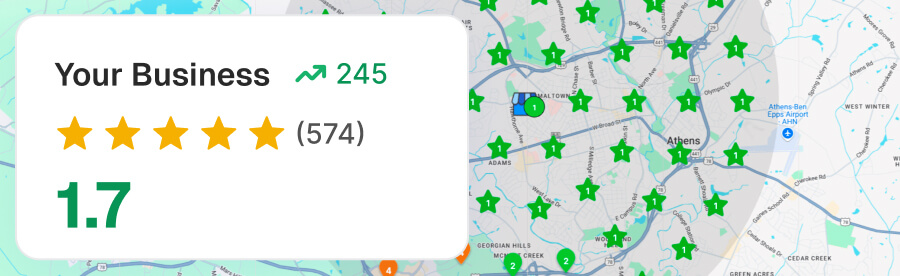
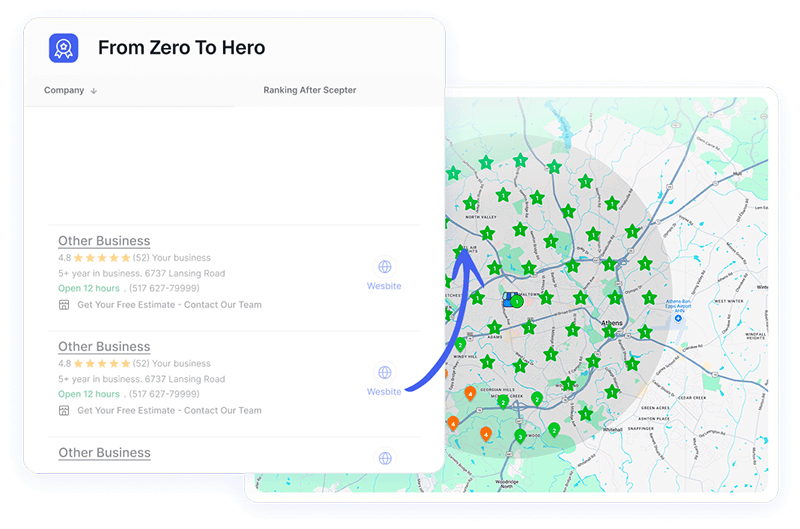
Ranking grids are how we measure that. We've published 99, covering 30 Business Profiles under our care, and each one tests Maps position from many points on a map.
The Plan
Each one puts that business among Google's first three results at no less than 60% of the spots tested. In 28 of them, it stays green everywhere.


Problem
Our own website had built up the kind of technical clutter an owner rarely spots: broken images and redirect errors.
The Plan
We audited it the way we'd audit a client's. One 2026 wave fixed 167 broken images and 141 redirect problems, the same unglamorous work a township business's site may need.
The Plan
Cohoctah sits inside our Michigan digital marketing coverage. If you only need one piece, SEO for Cohoctah businesses covers search rankings and Maps reach, and Cohoctah web design handles a site that's dated or broken.
Working past the township? Howell is about 9 miles off, and our Howell digital marketing page covers it. Hartland is about 12 miles away (Hartland marketing), Williamston about 16 (Williamston online marketing), and Brighton about 17 (Brighton digital marketing).


Problem
A Cohoctah business may get calls in spurts with no clear reason, because nothing records where those calls came from.
The Plan
For a business like that, grids across the towns it serves come first, then tracked numbers on every channel.
The Plan
The grids show where reach drops off. The call log shows which towns pay. Together they say where the next dollar goes.
This fits a township business that sells to people in several towns, has more word of mouth than online presence, and wants one team responsible for the whole plan. If a single listing fix is all you need, we'll scope just that piece.

Why this matters. These are the businesses that lose the most when their reach stops at the township line, and gain the most when listings, pages and tracking all point toward the towns where buyers search.

Why this matters. Marketing out here only pays when it's measured and given room to work. If referrals already fill your calendar, spending on search may not add much, and we'd tell you that up front.
Owners working out of Cohoctah Township usually want a handful of things settled before hiring anyone: cost, how long it takes, whether it fits farm-country work, and how they'll see what's paying. The answers below are written for a township business.
There's no single figure, because a farm-country business reaching into neighboring towns has a different job than one serving only its own crossroads. Three things move the budget: how many channels we run, whether you pay for ads on top of our management, and how much your site needs fixing first. Our audit shows which of those apply, and then we quote.
There's no honest date to give you, because it hinges on your starting point. Paid search can go live once Google approves the ads, and you pay per click from then on. Correcting a Maps listing usually moves sooner than a new page aimed at the towns around the township, which has to earn its rankings. Tracking records each shift.
Yes, as long as some of your customers search before they call. Farming is the main land use here, so a business serving farms may sell across a wide area. A complete listing, pages for the services and towns you cover, and reviews from past customers carry that reach. Ads can stay limited to those towns.
Rarely, if you want new customers. Social posts reach people who already follow you, and in a township of about 3,200 people that's a short list. Someone who doesn't know you yet is more likely to start on Google or Maps. Keep posting if it works for you, and put the main effort into the listing and your pages.
With tracked phone numbers, form source tracking and ranking grids. Each call is logged with the channel and town it came from, and the monthly report puts those calls next to cost, so you see what's paying.
You'll see what Google and assistants such as ChatGPT pick up about your Cohoctah business today: whether your name, phone and address agree from listing to listing, whether your site answers basic questions, and the one gap worth fixing first. No charge, and no sales call afterward.
A township business doesn't need every channel. It needs the few that carry its name into nearby towns. These pairings fit a Cohoctah business best, and the free AI Visibility Check points you to the first fix.

This pairing does the heavy lifting. The listing covers searches near your address, and town pages for places like Fowlerville or Howell give Google a reason to show you there too.

A small, tightly aimed ad budget can bring calls from towns your pages don't reach yet.

Reviews from past jobs give a stranger in the next town a reason to trust a business they've never driven past.
Too Busy to Dive In?Got two minutes? Type your web address into our AI Visibility Check. There's no fee. You'll see how Google and the AI assistants describe your business right now, where your listings disagree, and which fix to make before anything else.