


By Matt Hall, Founder, Scepter Marketing
(covered by the s1 fix above: the claim is softened to "many of your likely buyers live past the city limits", and the townships are named as the city facts give them)
It's the same Maps and website work we run for businesses around Michigan, set up so Google treats a Williamston address as a fair answer for searches a few towns over.
If your business sits downtown or along M-43, the town alone probably can't fill your schedule. Google decides who shows up for people in the surrounding townships, and right now it may not be you. We find out who's getting those searches, then build your listing and pages to compete for them.
Google Ads reports no search volume for the Williamston SEO phrases, and this page drew zero Search Console impressions in six months. So the case for starting rests on your own trade's searches instead. Plenty of Williamston residents drive to Okemos, East Lansing or Lansing for work each day. A furnace repair query typed at a desk in Okemos gets judged from Okemos. We plan for that morning and evening split.
Compete for buyers in Williamstown Township, Wheatfield Township and the farmland around them, not just the blocks near your door.
Each review and listing fix adds to the last one.
Being found past the city limits is how a small-town business fills its calendar.
Google's map results lean hard on distance from the searcher, and in a commuter town that works against you on weekdays. A Wheatfield Township homeowner who looks up furnace repair over lunch is measured from wherever they work, and the listings closest to that desk get the first look. You can't move your shop. You can make Google confident you serve the whole area with an honest service area, a dedicated page per service, and reviews from customers out in the townships. Those signals build slowly, and whoever starts first sets the bar the rest have to clear. That's the reason to begin now. It isn't a promise of where you'll land.
Ads have a real use. Geo-targeting lets you show up in the townships and nearby towns on day one, which organic work can't match early. The cost structure is the problem for a business that serves a wide area. Every extra town you target adds more clicks to pay for, and nothing carries over once the campaign ends. Organic pages and a strong listing are slower to earn. Once they rank, the clicks they bring don't add to your bill. We usually suggest pairing the two at the start, then letting your call data decide how much ad spend still makes sense. We'll show you the numbers either way.
We haven't run your searches yet, so we won't guess who leads them. When "seo company williamston mi" was searched from inside the city, Google put a map pack of three businesses above the regular results, and you'll likely see the same layout for your own service. Listings that hold those spots across a wide area tend to share a few habits. Their categories match the work exactly. Their sites give each service its own page instead of one long list. Their reviews arrive steadily and describe real jobs. Downtown shops have one more audience. Williamston's antique and specialty stores are known around mid-Michigan, so some searchers are planning a day trip from farther out, and they need your hours, photos and directions to be right before they leave home. We build for both: the township neighbor and the visitor.

Leads arrive quickly, each click is billed, and the flow ends with the campaign.

Recommended

Our office is in East Lansing, about 11 miles from Williamston, and the whole team works U.S. business hours in Michigan. We plan around the way a commuter town searches, from work as well as from home. You'll get plain answers, a look at every change before it goes live, and proof you can open yourself instead of promises. If a line on this page sounds like sales talk, ask us to back it up.
O1

You reach someone in your time zone who knows what an Ingham County commuter town looks like on a map. Red Cedar Jubilee week hours, a new service, a closed day: we can update the listing while it still matters.
O2

Each piece of work has a named person behind it, and you approve changes to your site before they go live. No mystery edits.
O3

A ranking only matters if somebody picks up the phone. We track calls and form leads, and use rankings to steer the work.
O4

Our own listing and website get the same treatment we sell. One audit wave there in 2026 repaired 167 images and 141 redirects.
O1

A sensible starting point is Williamston and its two bordering townships. When Mason or Fowlerville begins sending calls, we add pages and service area for those towns on the same foundation.
In search work since about 2009, and still running our own agency, audit engine and website the same way.

Founder at Scepter Marketing
We start with geography. Before touching your site, we work out which towns and townships your jobs actually come from, then build everything around that area: the listing, the pages, the reviews and the report. The steps below run in that order, though you can begin with whichever one hurts most.

First we map where your buyers actually live and work. Then we test your main searches from spots spread over that territory to find where your listing holds up and where it slips.

You get a short, prioritized plan in writing. It names the first fixes, explains why each one matters for buyers outside the city limits, and names the measure we'll hold it to. Your front desk can read it in five minutes.
01
02

Page titles and section headers get rewritten in plain terms, and links between pages are rerouted so a township searcher reaches the right answer.

Thin pages that say the same thing get merged. We add short question-and-answer blocks too, since those often match the way people phrase a search on their phone.

Here this step carries the most weight. Every service you want calls for gets a dedicated page, as does every town you really serve, so a searcher two towns over finds a match.

No town page is a copy with a name swapped in. Each one shows real work in that area, answers a local question, and puts the phone number where a thumb can reach it.
03
04

We repair pages Google can't crawl, mixed-up settings, sitemap errors and slow loading.

A sound technical base means your new town pages actually get read and indexed instead of sitting unseen.

Your Google Business Profile gets the right categories and services. Business details match in every directory, and we go after honest local mentions.

Distance can't be changed, so these signals carry the load when the searcher is out in farm country or at a job across the county.
05
06

A monthly summary shows calls, form leads and profile activity, a ranking grid over your service area, and a short plain explanation of what moved and why.
A ranking tells us whether the work is landing. A ringing phone tells you whether it's paying. If a town isn't producing calls, we shift effort to one that is.
Here's the monthly work, item by item, with the reason each piece matters when many of your customers live outside a two-and-a-half-square-mile city. No shortcuts that risk a penalty.
What we do
We reword page titles, headers and the links between pages so a search for your service plus a township name finds a page that fits.
Why it works
Someone in Wheatfield Township picks the result that clearly names their need. Pages that do that win the click.
Where it shows up
More clicks from the searches you already appear for, and steadier placement on the ones that bring paid work.
What we do
We shorten load times, remove dead and duplicate pages, keep the sitemap current and confirm each page you care about can be indexed.
Why it works
Each new town page depends on this. A site with crawl problems can leave fresh pages unseen, so we clear the path before adding more.
Where it shows up
Quicker pages, fewer accidental drops from Google, and new pages that get found.
What we do
We go after mentions a genuine Williamston business can win: sponsoring a community event, joining a trade association directory, getting written up by local press. Every mention links to the page it backs up.
Why it works
Mentions earned from real groups keep their value. Bought links tend to become a liability.
Where it shows up
Stronger authority behind your town pages, which helps the whole site, not one page.
What we do
Service pages, a page for each township or nearby town you cover, and short articles answering questions your customers ask before they hire.
Why it works
A searcher in farm country types a specific job and a place. A page built around that exact pairing is what wins the phone call.
Where it shows up
Better placement for your service plus each town name, and more of those visitors picking up the phone.
What we do
We fill in every Business Profile field that counts: main and extra categories, services, hours, description and photos of your actual work. Listings on other directories get matched to it, and you get a simple habit for requesting reviews.
Why it works
For trades and shops here, the map is often the first thing a searcher sees. A complete, consistent listing gives you a fair chance at it.
Where it shows up
More calls, direction taps and profile views from searchers in the city and the townships that surround it.
What we do
Every month: calls, form leads, Business Profile activity and a ranking grid across your service area, plus the tests we're running.
Why it works
Short reports mean fewer meetings and one shared set of numbers.
Where it shows up
Spending decisions you can make with confidence, town by town.
Google weighs three signals on every map search. Relevance asks whether your listing fits the words someone typed. Distance measures how far that person is from you. Prominence grows with reviews and mentions. In a bedroom community, distance works against you, because many Williamston buyers search during the workday from a job in a larger town.

Query match alignment.

Reputation & Authority.

To the searcher.
Picture a Williamston plumber and a homeowner who lives in Wheatfield Township but works in Okemos (about 7 miles from Williamston). At noon that homeowner searches for a plumber, and Google measures distance from the Okemos office, so shops near that desk get the first look. The plumber can't change that distance. They can change the other two factors. Relevance comes from the right primary category, a services list that matches the job, and a site page for the township. Prominence comes from steady reviews and honest mentions. A searcher sitting in Haslett works the same way. When relevance and prominence are strong enough, Google can show a business from a few miles farther out. For a business here, that's the whole game.
Does SEO still matter when buyers ask AI? Yes. ChatGPT, Google's AI answers and similar tools still lean on the websites, listings and reviews that already rank. A buyer in the townships who asks for a recommended contractor near Williamston gets names pulled from those same sources. If your listing is thin and your site has one page, there isn't much for the tool to quote.
We built the AI Visibility Check on the same audit engine we use when sizing up prospects. Hand it a URL and it tells you whether ChatGPT and Google bring up the business, plus how they describe it. No fee, no sales call attached.
We have no Williamston client to point to, and we won't pretend otherwise. What follows draws on Maps grids from profiles we run (names withheld, and a sample rather than the full roster) plus cleanup we did on Scepter's own site.


Problem
A listing can look great from the owner's own parking lot and fade badly a few miles out.
The Plan
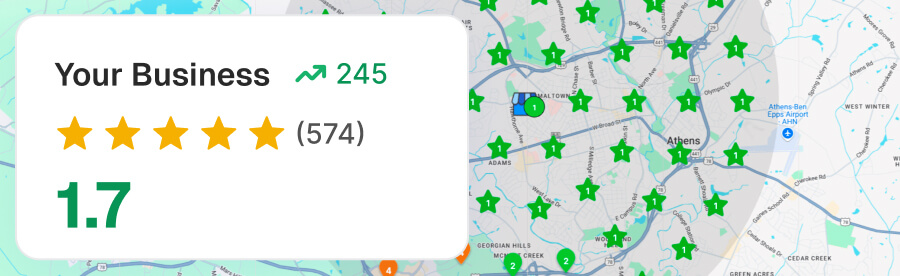
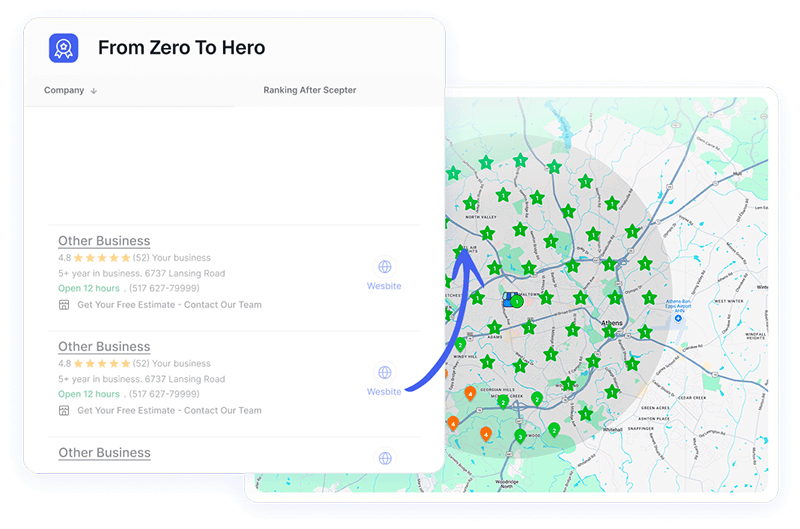
We measure rank at many points across an area instead of one. Our local SEO results page shows 99 of those grids.
The Plan
Those grids cover 30 Business Profiles we manage. In each one, the business holds a spot in Google's top three on no less than 60% of the grid points.


Problem
Our own website had collected 167 broken images and 141 redirect problems.
The Plan
One audit wave in 2026 cleared every one. We do the same tedious repair work on our own site that we sell to clients.
The Plan
The same discipline shapes our Michigan SEO work: fix the foundation first, then build pages for every area the business serves, then check the grids to see whether coverage actually widened.


Problem
One search from one spot tells you almost nothing about a service area that spans several towns.
The Plan
Twenty-eight of those 99 grids are solid green: a top-three spot at each point we searched.
The Plan
Names are hidden because most are clients of agencies reselling our work. Your own grid would be drawn around your actual area.
It's built for Williamston businesses whose customers come from past the city line: contractors and home service trades that drive out to township and farm properties, downtown antique dealers and specialty shops that draw mid-Michigan visitors, restaurants, and companies that serve the farms around town. If all you need is a listing cleanup, we'll do just that piece and price it separately.

Why this matters. Town pages need real job details, and reviews need real customers. We can build the structure, but the material comes from your work, and it's what convinces Google you cover the area.

Why this matters. Each part props up another. A page for Wheatfield Township without fresh reviews tends to slip, and a polished listing pointing to a slow, broken site drops the caller right before they dial. Skip one piece and the others carry less.
These are the six questions we'd expect a Williamston owner to ask before hiring anyone: what the work is, how to pick a firm, local versus national, cost, timing and AI. Short answers below.
A typical month splits between your Google Business Profile, your website and your reputation. On the profile, that means posts, photo updates, service edits and review requests. On the site, it means new or improved pages, often for a township or nearby town you want calls from, plus any technical fixes. A short report then shows calls, form leads and grid changes across your service area. For a downtown shop, hours and photos get extra care because visitors plan trips around them.
Pick the one that can show you proof and explain its plan for your actual service area. Ask any provider three things: which towns they'd build pages for, how they'll measure calls, and whether they'll show ranking grids instead of a single screenshot. In a commuter town like Williamston, a provider who only checks rankings from your own address misses a lot of your market. Skip anyone who guarantees a top spot.
A nearby agency usually makes more sense, though the work matters more than the zip code. Local search runs on your listing, your reviews and pages for the specific places you serve. A team that plans pages for the townships around Williamston, and for towns such as Dansville or Fowlerville if you serve them, is working the way the map works. A national firm can do good work too. Ask it to name the towns it would target. If it can't, that tells you something.
There isn't a set monthly number for Williamston, because three things move the price. One is whether we cover Williamston only or Williamstown and Wheatfield townships as well. Another is how crowded your trade already is across those places. The last is how much your site needs patched first. A downtown antiques dealer usually needs less than a builder covering half of Ingham County. The free check is where an honest quote starts.
No honest provider can pick the month for you. The earliest signs are usually Business Profile corrections and color shifts on a ranking grid. Township pages and a deeper stack of reviews take longer to pay off. The pace around Williamston depends on how many competitors already show for those nearby searches.
It might or might not, and a free AI Visibility Check shows you which. We run your business through ChatGPT, Google's AI Overviews and similar tools to see if they surface it for Williamston searches. Our own audit engine runs every check. You get findings, not promises.
Each of these closes a gap that small-town businesses with a wide service area tend to hit. Not sure which comes first? The free check shows the weakest link on your site or listing.
Besides search work, we take on Williamston digital marketing and build websites for Williamston businesses. If your customers come from past the townships, we also run SEO for Okemos (about 7 miles away), search work in Haslett (about 7 miles), Dansville local search (about 9 miles) and SEO around Mason (about 11 miles).

New town pages need a site that loads fast on a phone and makes calling obvious. If yours fights you, we can rebuild it.

Reviews from customers in the townships tell Google you really work there, and they reassure the visitor planning a downtown trip before they ever call.

Paid search can reach the nearby towns your pages don't rank in yet, so you have a way to show up there during the build.
Too Busy to Dive In?Short on time for a full plan? Enter your website address into our AI Visibility Check. You'll see whether Google or ChatGPT brings up your business when someone around Williamston asks for your kind of work, and which fixes we'd tackle first. It costs nothing.