


By Matt Hall, Founder, Scepter Marketing
Scepter Marketing provides digital marketing for Stockbridge businesses: your Google Business Profile, local SEO, your website, reviews and Google Ads, run as one plan and judged by the phone calls it brings in. Digital marketing in Stockbridge has a twist. The village holds 1,244 people, so most of your future customers live somewhere else.
That changes the job. A listing that ranks well on the village's own streets can drop away by the time someone in Gregory, about 5 miles off, searches for the same service. We build for the towns you actually drive to, measure your reach there with a ranking grid, and report what came in: calls, form fills and booked work, in plain words.
Yes, Scepter Marketing does digital marketing for Stockbridge businesses, and we measure it in calls. The catch here is size. The village covers about 1.53 square miles, so growth means getting found in the towns around it, which most listings are never set up to do.
Picture a homeowner in Dansville, about 10 miles away, who needs a furnace looked at. They search on their phone, tap a listing in Maps, open the website to see if you cover their road, then scroll the reviews. Three pieces, one decision. If the listing never shows outside Stockbridge, the website and reviews don't get a turn. If it shows but the site is broken, the click is wasted.
A profile tied to a small village needs help to show up for searchers in the towns where most of the work is.
Someone 12 miles off wants proof you'll come out. Clear service pages and a working contact form give it.
A stranger from another town has never heard of you. Recent reviews answer the question they won't ask out loud.
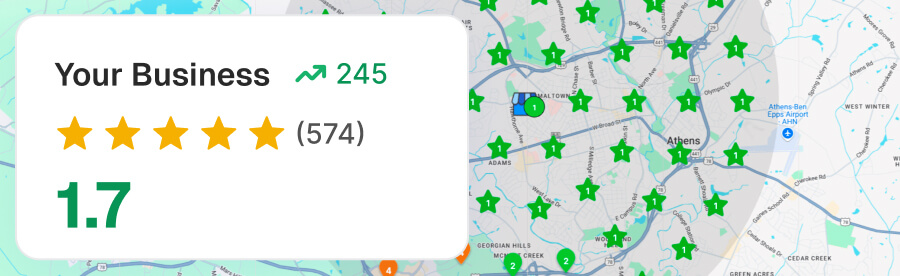
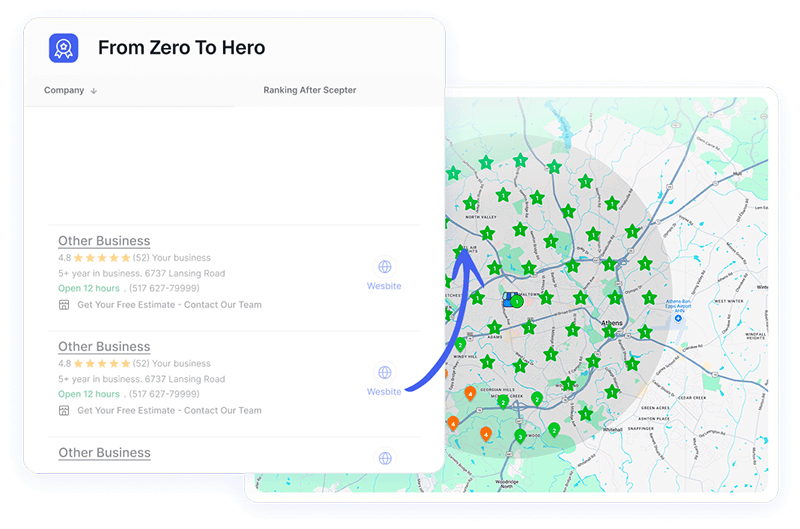
Google decides which businesses to show in Maps partly by how close they are to the person searching. For a shop in a dense suburb, that works in its favor. For a business in a village of 1,244, it cuts the other way. The searchers close to your address are few, and the ones 10 or 15 miles out see whoever sits nearer to them. A business can have a decent profile and still get very little from it, because nobody gave Google a reason to show it farther out: service pages for those towns, reviews from customers there, categories that match the real work. A grid makes this visible. It checks your rank at points spread across a map, and the outer points are where a small-town listing is most likely to go quiet. We start there, because you can't fix reach you haven't measured.
Say you hire one person for the website, pay a second for ads, and handle the Google profile yourself on slow evenings. Each one can say their part is fine. The ads send a searcher 12 miles out to a page that never mentions their town. The website changes your phone number and nobody updates the profile. Reviews stall because nobody owns asking. None of these is a disaster alone. Stacked up, they're why a small-town business pays for marketing and still hears mostly from the village.
With one team on all of it, the pieces get planned against the same map. The service pages name the towns the profile is trying to reach. The ads, if you run them, point at those same pages and stop where your Maps listing already shows. Review requests go out after each job, so customers from outside the village leave their words where the next searcher will read them. The phone number, hours and address match everywhere, because one person checks them. It costs a bit more than doing it yourself. It also plugs the gaps where money leaks.
For most Stockbridge businesses we'd lead with the Google Business Profile and pages built for the surrounding towns, then add the rest around them. The order matters. A profile with the right categories and a service area that matches where you drive gives Maps something to work with. Town pages on the website give Google a reason to connect you with searches made 10 or 16 miles away. Reviews from those customers back the pages up. Ads come later, if at all, and only on the services and towns where the grid shows you're still missing. A busy suburb might flip that order and lean on ads early. A village this size needs reach first. Everything else gets easier once Google will show you past the village line.

Free in dollars, costly in evenings. The profile gets updated when you remember, and nobody checks whether you show up two towns over.

Someone runs the ads or the website well enough. Nobody connects it to the profile, the reviews, or the calls that actually came in.
Recommended

Profile, town pages, reviews and any ads planned as one, measured by grid and by the calls you can trace.
We show our work. The ranking grids we use to measure Maps reach are published on our site, so you can judge the method before you hire us. Behind them is a Michigan-based team, answering during normal U.S. business hours, and one group running every channel you buy from us.
O1

If we can't explain a change in a sentence, we shouldn't be making it. You'll hear what we're doing to your profile or site, the reason it matters for reaching customers outside the village, and what we'll look at to judge it.
O2

We're based in Michigan and keep U.S. business hours. A question you send mid-morning reaches people working the same day you are, who already know your profile and site.
O3

A grid checks your Maps rank at many points around your address. For a Stockbridge business, the points out toward the next towns matter most, and we report them plainly.
O4

Your listing, website, reviews and ads sit with us, not with three vendors. If the number on your profile is wrong or a town page is missing, there's one place to send it, and no one to blame but us.
O1

Starting with only the profile is fine. When you want to reach farther, we add town pages, review requests or ads to the same plan, measured the same way, so nothing earlier gets thrown out.
In a small town, the searches inside the village aren't where most of the work is. The first thing I'd ask any agency: can they show me where I rank three towns over?

Founder at Scepter Marketing
The steps don't change much from client to client. What changes is where they point. For a Stockbridge business, every step is aimed at one question: can people in the towns around the village find you, and do they call? We audit first, fix what's broken, build Maps and search reach outward, add ads where they're worth it, and report on what came in.

We look at your Google profile, your site and your reviews, then run a grid that reaches well past the village to see where Maps stops showing you.

Say you install septic systems out of Stockbridge. The audit would cover whether your categories fit that work, whether the site has a page for each town you drive to, how your reviews read, whether your phone and address match across listings, and the grid points where you vanish. You get it in writing, ranked by what to fix first.
01
02

Before anything changes, we set up call tracking and form tracking, so a call from your Maps listing can be told apart from one that came off a town page.

This matters more in a small town than people expect. Most of your calls may come from outside Stockbridge, and an owner usually has a rough sense of which towns, not a count. Tracked numbers on the profile and the site, plus form tracking and a field asking where the customer lives, turn that rough sense into a list. Then the next steps can follow the towns that actually call, instead of the ones that feel busy.

Next comes the groundwork: fixing what the audit flagged on the site, tightening the profile, and adding pages that describe your work in the towns you cover, so Google has cause to show you there.

Town pages only work if they say something real. A page for a nearby town should explain what you do there, how far you travel, and what customers there have hired you for, instead of repeating one paragraph with a new name. Reviews help the same way. When a customer 13 miles out describes the job, the next person from that area reads it as proof you'll make the drive.
03
04

Paid ads aren't automatic for a village business. If the grid shows a town where you still don't appear for a service that pays well, a small Google Ads campaign can cover that gap.

We keep ad campaigns narrow on purpose. One service, the towns where you're missing, a page that matches the ad. Spend goes to searches that turn into calls, and we cut the ones that don't. Ads stop the moment you stop paying, so the aim is to lean on them less as your profile and pages build their own reach.

Each month you see the calls and forms, which channel brought them, what you spent, and the grid next to last month's, so reach outside the village stops being a guess.

Rankings alone don't pay anyone, so they aren't the headline of the report. Calls are. If the grid improves toward one town but the phone stays quiet there, we say so and look at the profile, the pages and the reviews for the reason. If calls from a town climb, we put more effort there. You'll read it quickly and know what we're changing next.
05
06

When one town starts producing calls, we take the same approach to the next one on your list, using what the tracking showed about which pages and services worked.
Expanding one town at a time keeps it honest. Each new area gets its own grid points and its own line in the report, so you can see whether the move paid off before adding the next. Some businesses stop at the closest few towns, and that's a fine place to stop if that's where the profitable jobs are.
Here's what the work covers, and what each piece is there to fix. Local SEO and the Business Profile come first because, in a village this small, reach into the surrounding towns matters most. Ads, tracking and reporting support that work. If a piece doesn't fit your business, we leave it out and say why.
What we do
We fix technical problems on your site, then build pages for the services you sell and the nearby towns you cover, each with details a searcher there would actually check.
Why it works
Google needs a reason to connect a business in a small village with a search made in another town. A clear page about your work in that town, on a site that loads and works, is one of the strongest reasons you can give it.
Where it shows up
In the grid, at the outer points. In Search Console, as impressions and clicks on searches that name nearby towns. In your call tracking, as calls from customers who don't live in Stockbridge.
What we do
We run small, tightly targeted Google Ads campaigns for the services and towns where you aren't showing organically yet, each sent to a matching page.
Why it works
Ads appear as soon as they're approved and running, which makes them useful for a gap the slower work hasn't closed. They also cost money every day they run. Kept narrow, they cover a specific hole instead of competing with your own Maps listing.
Where it shows up
In the ad account and the call tracking: which search terms brought calls, what each one cost, and which ones we switched off.
What we do
We set categories that match your real services, write the description, add photos of actual jobs, keep hours and contact details right, and send review requests to customers after the work is done.
Why it works
The profile is usually the first thing someone in a nearby town sees. Wrong categories keep you out of searches you should be in. Thin reviews push a stranger 10 miles off toward a name with more of them. Both are fixable, and neither needs a big budget.
Where it shows up
In the profile's own numbers: calls, website taps and direction requests, plus a grid marking where the listing shows and where it doesn't.
What we do
We write pages and posts that answer what people in the area ask before hiring: what a job involves, whether you serve their town, and how to book.
Why it works
A searcher in another town decides whether you're worth calling before they've spoken to you. Plain answers on the page help with that, and they're also the kind of text AI assistants tend to quote.
Where it shows up
In Search Console impressions on questions and service terms, in time spent on those pages, and in form fills and calls that start from them.
What we do
We put tracked numbers on your profile, your website and your ads, set up form tracking, and ask each new customer which town they're in so the report can show it.
Why it works
An owner in a small town often knows roughly where calls come from. Roughly isn't enough to decide where to spend. Tracking turns the hunch into numbers by channel and by town.
Where it shows up
In the monthly report: calls and forms by source, by town where the customer told us, and the cost per call for anything paid, next to what we changed that month.
What we do
One short report a month: what we changed, what came in, what it cost, and what's next. Written so you can read it without us on the phone.
Why it works
You can decide whether to push into another town, add ads, or hold steady, based on numbers instead of a feeling about last month.
Where it shows up
In your inbox, and in a monthly call if you want one. Questions get answered in plain words.
The village counted 1,244 residents at the 2020 census. For a business based there, the people inside the village are a short list. Most of the customers worth chasing live in the towns around it, and that's where a listing has to show up.

Calls from beyond the village.

Reviews strangers can read.

One team aiming every channel at the nearby towns.
Picture a tree service based in Stockbridge with a decent profile and a handful of reviews. Searches inside the village find it. Someone in Pinckney or Leslie, about 12 or 13 miles away, can search the same service and see only businesses closer to them. The fix: categories that fit the work, a page for each town that says what you do there, reviews from customers in those towns, and a grid that checks whether the outer points improve. Searches that name the village are few even for our own service. Google's ad tools report no search volume for “stockbridge mi digital marketing,” and this page drew 6 impressions in six months on “stockbridge digital marketing agency.”
Some people put the question to ChatGPT instead of Google, something like: “Who can pump a septic tank near Stockbridge?” Google does its own version. It showed an AI Overview when we searched “digital marketing company stockbridge mi” from inside the village. Those answers lean on what agrees across the web: your profile, matching listings, reviews describing real jobs, and a site that says plainly what you do and where.
We can't promise an assistant will name you, and no one honest can. What we can do is make those inputs agree. The free AI Visibility Check reads your site and shows how Google and AI tools describe your business today, plus which details are missing or don't match.
Two pieces of proof, both checkable, neither from Stockbridge. One shows how we keep client work running when an agency's delivery falls apart. The other shows how we measure Maps reach with grids, the same tool that would tell us whether a village business shows up in the towns around it.


Problem
An agency partner had 7 active SEO clients when their SEO person left. Some of those sites sat on a custom CMS. The client work still had to ship.
The Plan
We stepped in and took over the delivery without a pause for any client, custom CMS sites included.
The Plan
Once delivery was steady, the partner grew from 7 to 30 active client accounts. We cite it as evidence our process holds up, not as a local ranking result.


Problem
A Business Profile can rank well on its own block and still disappear a few miles out. Without measuring, nobody sees where it drops.
The Plan
We measure Maps reach with grids. Our results page shows 99 grids drawn from 30 profiles we manage, each with the business among Google's first three at no less than 60% of the points checked.
The Plan
This page is one part of our digital marketing across Michigan, run by our team in East Lansing. Every city page we publish, like this one for another Michigan town, is written for that place. If people already find your site but don't call, pair this with SEO work for Michigan businesses so the pages they land on give them a reason to.


Problem
Here's how the grid method would apply here. A business in a village this small needs to know whether it shows up in the towns where most of its work is, not only at home.
The Plan
We'd spread the grid past the village edge, far enough to reach Gregory at about 5 miles and Fowlerville or Mason at about 16, then read where the listing fades.
The Plan
None of the 99 grids comes from Stockbridge. The businesses go unnamed on purpose: most reach us through agencies reselling our SEO. It's a selection too, not every client.
A fit if you're based in or near Stockbridge and your jobs take you into the surrounding towns, or if you count on people passing through, such as those starting the Lakelands Trail at its westernmost trailhead in the village. You want one team handling your listing, website, reviews and any ads. It's not a fit if you need a firm date for results or only want social posts, and we'll tell you that up front.

Why this matters. A village business grows by reaching outward, and reach is easy to claim and hard to prove. Owners who want it measured, and who'll stick with one plan long enough to read the numbers, tend to get the most from this work.

Why this matters. Reach into nearby towns builds from many small fixes: categories, pages, reviews, consistent listings. A single post or a rushed campaign touches few of them. A low quote with no measurement behind it leaves you unable to tell whether anything worked, which often means paying someone to redo it later.
These are the questions owners ask before hiring an agency for a business based in a small village. Each answer starts short, then covers what's different about Stockbridge and what to do next. Nothing here promises a ranking or a date.
Cost for a Stockbridge business comes down to how many pieces you need and what shape they're in, so we price after looking rather than from a list. Fixing a profile and adding pages for a few nearby towns costs less than that plus a rebuilt website and running ads. Ad spend goes to Google, on top of our management fee. The number of towns you want to reach matters as well, since each adds pages and grid points to the work. Start with the free AI Visibility Check. We audit from there and quote from what we actually find, instead of guessing.
The right fit is an agency that can show where you rank in the towns around Stockbridge, not only at your address, and can tell you exactly who does the work. Ask for a sample ranking grid. Ask whether the person you meet is the person who'll edit your profile. Ask what they'd skip for a business your size. We publish our grids, our Michigan-based team does the work itself, and we'll tell you if one piece is enough to start.
For a business in a village like Stockbridge, an agency's main job is getting you found by people who don't live in the village. In practice that's the Business Profile, pages on your site for the towns you cover, review requests after jobs, fixes to anything broken on the site, and ads only where there's a gap. Underneath it all sits tracking, so you know which towns actually call. A monthly report shows what changed.
For most rural businesses, two or three types do most of the work: the Google Business Profile, local SEO aimed at nearby towns, and reviews. Ads help when a specific service or town is missing and you want calls before the organic work fills in. Website fixes matter if the site is slow or broken. A business based in Stockbridge can often skip social media ads and email at first. We'd rather you spend on reach into the next towns before anything else.
We track calls and form fills by source, and we record the customer's town, so results come out by channel and by place. That shows whether a call came from Stockbridge Township or a town farther out. Tracked numbers go on your profile, your website and any ads. The grid adds the visibility side, showing where in the area the listing appears. Each month the report lines those up, so you can see whether reach into a town is turning into calls from it.
It shows how your business looks to Google and to AI tools such as ChatGPT, based on your website, and flags what's missing or inconsistent. For a Stockbridge business, the thing to watch is whether your profile and site say which nearby towns you serve. It's free, takes about 30 seconds to run, and there's no sales call attached.
For a business based in Stockbridge, the pairing that usually makes sense is the Business Profile plus SEO aimed at the surrounding towns. Reviews support both. Ads join only when a town or service still won't show. Here's how each piece fits.
Need only one piece? See SEO for Stockbridge businesses or web design in Stockbridge. Serving towns farther out? Read our pages on marketing for Dansville, about 10 miles away, Pinckney digital marketing, about 12 miles, and Leslie online marketing, about 13 miles.

This is the main pairing for a village business. The profile gets you into Maps, and town pages on your site give Google reasons to show that profile in places several towns away.

If one town keeps showing empty on the grid, a small ad campaign can fill that spot. It runs only as long as the gap does.

Reviews from customers in other towns tell the next searcher there you already work in their area. We ask after each finished job, by text or email.
Too Busy to Dive In?Not sure where to begin? Put your website into the free AI Visibility Check. It shows how Google and AI tools currently see your business. For a Stockbridge business, it's a quick way to spot whether anything tells them you work beyond the village.