


By Matt Hall, Founder, Scepter Marketing
Scepter Marketing designs websites for businesses in Onondaga, and we plan each one around the whole area you work, not one ZIP code. If your shop is in the township but most jobs come from Leslie or Mason, those are the towns your site has to reach. That's our approach to web design in Onondaga.
We write and build pages that open quickly on mobile, name the towns you really work in, and keep your number one thumb away. After launch, we track which page brought each call.
Scepter Marketing plans, writes and builds websites for companies in Onondaga, aimed at one result: phone calls. With 2,997 residents counted in the 2020 census, growth often means winning work in the surrounding towns too, so that's where we aim the pages.
Onondaga Township covers about 36 square miles of Ingham County, and its 49264 ZIP code also reaches into smaller parts of two other townships. So the address on your site describes where you work from, not where your customers live. A site that talks only about the township misses a lot of the people who'd hire you. That gap rarely shows up in a report. It shows up as a quiet phone.
Pages built for the towns where the work is give those searchers a reason to call you.
Your own job photos, a named service area and a clear phone number stand in for the sign out front.
A tidy page structure and separate pages for the towns you cover let Google show you to buyers outside the township.
Picture a small excavation and drainage outfit working out of a pole barn in the township. A homeowner in Mason, about 9 miles away, needs a culvert replaced and searches from a grocery store parking lot. The outfit's site is one page with an Onondaga address, and it never says the crew works in Mason or Holt. Google has little reason to show it, so the homeowner calls whichever company names their town. The fix is plain work: a page for every town the outfit really covers, photos from jobs there, and a call button sized for that parking-lot phone.
A drag-and-drop template is a fair starting point for a new outfit offering one service. The limits show up once you want a page per town, a quote form that routes where it should, or real speed on an older phone. Most templates fight you on all three, and the workaround is usually starting over.
Doing it properly the first time costs more on day one. In return, adding a new town, a new service or a seasonal offer means adding a page, not starting a second project. The site keeps its speed as it grows, and you stop wondering whether it's the reason a week went quiet.
A brochure site says who you are and stops. A working site answers the next three questions a stranger has: do you cover my road, can I see work like mine, and how fast can I reach you. In a township this size, the first question matters most, since a lot of your work probably comes from outside it. Back to the drainage outfit: once its site names the towns it serves and shows jobs from each, it finally has something to say to that parking-lot searcher. Every page ends in one next step, a call or a short form, and we track which one people use.

Quick to set up. Then you hit its walls the first time you want town pages or a form that does more than email you.

Can look fine at handoff, then slow, hard to change, and unreachable once they move on.
Recommended

Light, owned by you outright, and set up to win calls from every town you serve.
We're a Michigan team keeping U.S. business hours, working from our East Lansing office. The same people who design your pages also run your search and Maps profile work. If your calls come from a handful of towns instead of one, I think that pairing matters more than anything else on this list.
O1

The pages, your Google Business Profile and the local rankings all sit with one crew, so the towns your pages name match the area your profile shows.
O2

Questions get answered during the U.S. workday by people in Michigan, and you see drafts before anything is public.
O3

Our founder, Matt Hall, has worked in this field since about 2009. Every build we do is aimed at the phone, not at looking good for its own sake.
O4

Quotes start after our own audit engine has scored your current site, so the plan rests on evidence.
O1

Start with a few core pages. When jobs pick up in Leslie, about 6 miles away, or you add a new service, the site takes another page without a rebuild.
We do the unglamorous technical work we sell on our own site too. One audit wave in 2026 fixed 167 broken images and 141 redirect problems.

Founder at Scepter Marketing
Here's the order a township build runs in, and what we'll ask of you at each stage. You tell us which towns you take work from and send pictures from recent jobs. We handle the writing, design, build and tracking.

We start with a short call about the work you do, where your jobs land on a map, and what a good week of calls looks like for you.

You leave with a page list ranked by importance, the towns each page targets, and the single action each page asks for. It's written so anyone in your business can read it.
01
02

Layouts start from your logo and colors, then get shaped around the single move we want a first-time visitor to make. Nothing gets coded until you've approved the look.

First up: your homepage, the main service page and one town page. That trio does the heavy lifting with a stranger deciding whether you're worth a call. We draft mockups of those three, you send back notes, and nobody writes code until you sign off.

A lightweight setup keeps each page quick on any screen and simple for you to change later.

We strip out code the page doesn't use, shrink every image, and skip heavy plugins. That matters to someone sizing you up from a job site on an older phone. If a page drags, they back out to the results and try the next name.
03
04

Forms, tap-to-call buttons and call tracking go in so nothing a customer sends goes missing.

Each form entry goes to whatever inbox or phone you name. On every screen, the call button sits within a thumb's reach. Tracking tags each lead with the page and town it started from, which tells you where the next town page belongs.

Tidy code, honest headings and a page for each area you serve give Google a clear read on where you work.

A nice look won't get you found. Clean structure, proper titles and schema markup let Google and AI answer tools read each page without guessing, which gives later SEO work a firm base to build on.
05
06

We test everything before the switch, then stick around for fixes, edits and new town pages.
Ahead of going public, every link gets clicked, every form gets a test entry, and each page gets opened on a small screen and a desktop. Once it's out, we stay on for repairs and new pages as jobs pull you into other towns. The logins stay yours, so you're never stuck waiting on us.
Nothing below is filler. Each piece helps a township business show up in the towns its customers search from, then turns that visit into a call. Anything that can't do both stays off the list.
What we do
We design your main pages around your brand and the jobs you actually do, using your own photos rather than a stock theme someone else is also using.
Why it works
A stranger from a nearby town has never seen your shop or your trucks. A site that clearly looks like your business is the first evidence you're real and still operating.
Where it shows up
A first-time visitor gets enough of a feel for you to pick up the phone.
What we do
We build on lean code and leave out the theme bloat and plugin piles, so pages stay quick from the first one to the twentieth.
Why it works
Slow pages send people back to the results. A light build stays quick as you add towns and services.
Where it shows up
Pages open fast, people stay to read, and speed holds as the town pages pile up.
What we do
We get the technical basics right: headings, page titles, schema markup, internal links between town and service pages, and a structure search engines can follow.
Why it works
A soundly structured site is easier for Google to understand, and it tends to weather Google's changes better than a patched one.
Where it shows up
A real starting point for showing up past the township line, with pages ready for SEO from the first day.
What we do
We design every page for a phone first. People checking out a business from a truck, a driveway or a parking lot don't sit at a desk to do it.
Why it works
If the menu is fiddly or the number is hard to tap, a phone visitor gives up fast. An easy layout keeps them moving toward a call.
Where it shows up
Fewer people bail, and more of them tap the number or finish the form.
What we do
We hook up each form, call button and tracking tag, then test them by hand, so every inquiry reaches you labeled with the page and town that sent it.
Why it works
A broken form loses work you never hear about. Working forms and one-tap calling put you in a real conversation instead.
Where it shows up
Nothing goes missing, and you can see which town pages are sending real work.
What we do
You get short instructions for everyday edits like hours or photos, and we take the bigger changes.
Why it works
When small edits take minutes, the site keeps up with your season and your crew.
Where it shows up
Swap a photo or update a service yourself, without paying a developer each time.
You can check your own site for this in a few minutes. Open it on your phone, away from Wi-Fi, and ask three questions: did it open quickly, does it look like a real business, and is there one obvious way to reach you?

Quick on a phone.

Credible on sight.

One obvious action.
Speed: load your homepage on a phone over cellular data. If you're waiting, so is everyone else, and some of them won't. Trust: look for your own photos, a named service area and reviews you can point to. With no storefront for a stranger to drive past, those do the heavy lifting. Next step: count the ways to reach you on the homepage. One clear one, a number that dials on a tap, beats five buried links. Then add a fourth check that matters for a township business: search your service plus a nearby town you work in. If your site never mentions that town, that's the first page to write.
Searched from inside the township, “web design company onondaga mi” opens with an AI Overview, then three businesses on a map, then the usual links. A search for your trade could open the same way. Those summaries pull from pages they can parse easily, and a thin site hands them nothing usable.
A tidy page structure that keeps load times low also hands those tools text they can lift without guessing. Our AI Visibility Check runs on an audit engine of our own, the same one behind our real prospect audits. Enter your site and it tells you how Google and the answer tools describe you today, and which repairs would change the picture.
The proof here isn't from Onondaga, and we don't claim it is. It's two things we can point to: map rankings for business profiles we manage, and an agency whose SEO delivery we took over midstream.


Problem
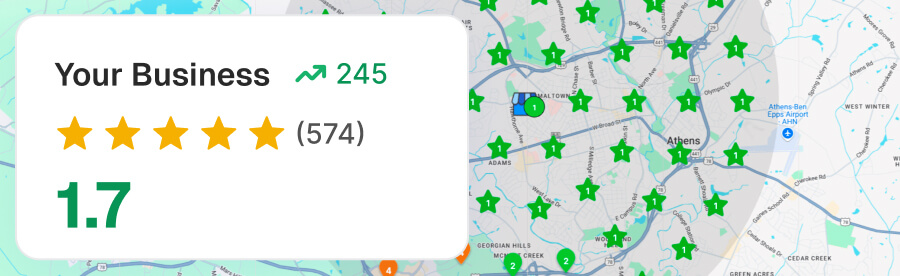
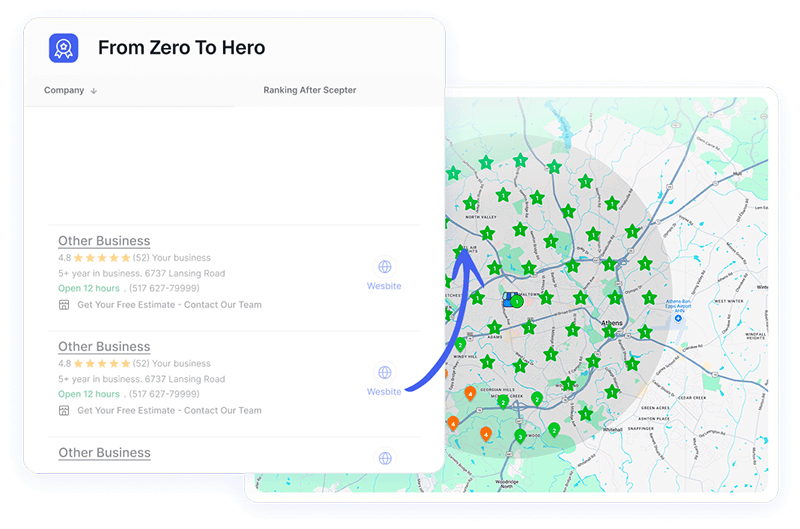
Ranking in the map pack at your own address is the easy part. The real question is whether you show up at the points where your customers are searching.
The Plan
The grid page holds 99 snapshots from 30 Business Profiles we manage. In every one, the listing ranks top three across 60% or more of the map, and 28 of those grids are solid green.
The Plan
Twenty-eight of those grids are green, meaning top 3, at every single point. That's the kind of spread a township business needs.


Problem
An agency partner had 7 active SEO clients and suddenly no one to do the work after their SEO person left.
The Plan
Their SEO person had left with 7 clients still active. We kept every account moving, the custom CMS builds too, and after the work settled the partner climbed to 30 active accounts.
The Plan
Reliable handoffs are what this proves. Onondaga sits under our statewide Michigan web design practice. If being found is where your site falls short, add Onondaga SEO to the rebuild, and one crew owns both the pages and how they rank.


Problem
No business names appear in those grids, deliberately. Most of those businesses are clients of agencies that resell our SEO. It's a selection too.
The Plan
So we say it straight: the grids are a selection, not every account we run. Judge them as a sample, and ask us anything on a call.
The Plan
We'd rather hand you a smaller set of checkable results than a polished story we couldn't back up.
Here are some builds from our own files, and none of them sit in Onondaga. Each card covers what we made and the piece a township shop could reuse.
A product site built around pages a buyer can scan. For you: build the base so the next service page is easy to add.
Built so new sections can drop in cleanly later. A township business wanting to add towns one at a time needs the same bones.
Mobile-first pages built so the essentials read without pinching and zooming. Your version: phone number and service area, readable in one glance.
WordPress pages for a business-to-business firm, built to look serious from the first screen. If you sell to other companies, a serious-looking site starts the selling before you call back.
A product site built around pages a buyer can scan. For you: build the base so the next service page is easy to add.
Built so new sections can drop in cleanly later. A township business wanting to add towns one at a time needs the same bones.
Good fit: a township-based business whose jobs come from a ring of nearby towns, with a site that doesn't say so. Maybe yours is dated, slow, or just quiet. Then a conversation makes sense. If the only problem is one broken contact form, we'll tell you that and fix the form instead of pitching a rebuild.

Why it's a fit. The township businesses that get the most from a rebuild already do good work in several towns. The site just needs to catch up and say so.

Why we say no. A build we expect to disappoint you wastes your budget and our time. We'd rather point you somewhere better suited than take the job.
These are the questions a township owner should ask before hiring anyone: price, pace, phone performance, and showing up past the township line. Here are straight answers.
It comes down to scope, and we quote it after a scoping call rather than from a price sheet. For a township business, the biggest lever is usually how many nearby towns deserve their own page. Writing the copy for you adds to it, and so does hooking the site into a booking calendar or estimate tool. You'll get the figure in writing before anything starts.
There's no single number, because the biggest factor is how quickly your photos, service details and design approvals come in. Extra integrations and more revision rounds stretch it. After scoping, we give you a realistic estimate, not a guaranteed date.
It should, if it's built light, and that's how we build. Images get compressed, code stays lean, and every page is designed for the phone first, so it opens quickly on a slow connection. We test on mobile data before launch, not just office Wi-Fi.
It needs to prove you're real without a building to point to. That means the towns you cover, plain descriptions of each service, photos from actual jobs, reviews, and a phone number that dials on a tap. A clear service area replaces the street sign a shop would have.
Yes. If you take jobs in those counties, we name them on the site, add pages for the specific towns where the work is, and set your Google Business Profile service area to match. Visitors and Google then see you cover more than Onondaga Township.
Yes, and it costs nothing. Type your site's address into our AI Visibility Check and a report comes back showing what Google and AI chat tools say about your business, plus speed scores for phones. The Measures Up widget near the top gives a faster read. Nobody calls you afterward.
Google Ads shows no reported monthly searches for “web design onondaga mi” or the two related terms. In a township of 2,997 people (2020 census), most work tends to come from further out. So we'd put a new site alongside search and Maps listing work aimed at the wider ring of towns your jobs come from.
Want the wider marketing picture? Our page on Onondaga digital marketing covers it. Serving the next towns too? Look at web design for Leslie (about 6 miles off), Mason web pages (about 9 miles), or building a site in Holt (about 12 miles).

A site only brings calls from places where it shows up. Our SEO work targets the searches people make in the towns you actually serve.

Real Google reviews tell someone a town or two away that other people hired you and were glad they did.

Paid search puts you in front of nearby searchers while organic positions are still building.
Too Busy to Dive In?Busy week? Run the AI Visibility Check first. It's free. Drop in your web address and it shows how Google and answer engines see your business, how fast the site opens on mobile, and which repairs would likely bring more calls from around Onondaga.