


By Matt Hall, Founder, Scepter Marketing
Scepter Marketing does Holland MI web design for businesses that care more about a ringing phone than a prettier homepage. We build websites for Holland companies on both sides of the Ottawa and Allegan county line, and we plan each one so people searching across West Michigan can find it, read it and call.
You get a mobile-ready site, a tap-to-call number, a short form and search basics built in from the first page. Then we track what it produces, so you can see which pages earn inquiries.
Scepter Marketing builds Holland websites meant to produce calls, from buyers in town and from people searching across West Michigan. The same team handles the SEO, so your build and your rankings aren't two separate projects.
Holland's economy leans on manufacturing, and the city is home to Herman Miller, Haworth and Adient. That shapes who goes looking for local suppliers. A purchasing manager hunting for a fabrication partner may type “West Michigan” instead of “Holland,” and a site that only talks about one town can miss that search entirely.
Pages written for West Michigan as a whole can catch searches that one-town copy never reaches.
Industrial buyers want capabilities, equipment and past work on the page before they ask anyone for a price.
Titles, headings and page structure get handled during the build, so search work later starts from solid ground.
The miss usually looks like this. The shop's homepage says “Holland, Michigan” once, in the footer. Its capabilities sit in a PDF that opens badly on a phone. There's no page about the region it serves, and no quote form, just an email address. So a purchasing manager in Grand Rapids, about 26 miles away, searches for a supplier in West Michigan and never finds it. The fix is plain work. We turn the PDF into real capability pages written in the buyer's words, state the service region in the page text, put a short quote form on every page and track which page sent each request. Then SEO has something worth ranking.
A template is fine for a new business with three pages and no catalog. It strains once you need dozens of capability pages, spec sheets and a quote form that accepts drawings. Plenty of themes load scripts for features you'll never touch, and leaving one later often means starting over. For a Holland firm that sells to manufacturers, that restart tends to land at a bad time.
Doing the build properly once changes the arithmetic. Every capability earns a page of its own, the quote request accepts drawings and spec sheets, and the layout leaves room for a new product line or a second plant with no redesign. The upfront bill is higher. The aim is that growth adds pages to the site you already have instead of forcing a second build.
Holland is the largest city in both Ottawa and Allegan counties, and a supplier here often sells across both and beyond. Whoever lands on the site wants three answers fast. Can you make it? Have you made it before? How do I get a price? Capability pages handle the first. Finished-part photos and the industries you serve handle the second. A quote form on every page and a number that dials on tap handle the third. Get those right and the site earns its keep.

Quick to publish and cheap each month, but every capability page you add fights a layout designed for somebody else's business.

Fine until the files live on one person's laptop and that person stops answering email.
Recommended

You own it, it's tracked from day one, and our SEO team shaped it from the start.
Each claim here is checkable. We're a Michigan team out of East Lansing, reachable during normal U.S. workdays. Matt Hall's run in this business goes back to about 2009. And the people who build your site also handle search and Business Profile work, which fits a query that brought up this page: “web design companies holland mi with good seo services.”
O1

You'll hear what we're changing and why in the words your sales team already uses. If a buyer wouldn't say “responsive breakpoint,” neither will we. Each recommendation comes with the number it should move and how we'll check it.
O2

We're in Michigan and keep U.S. business hours, so your questions land during our workday, and the person doing the work is the one who answers.
O3

A first-page ranking that never produces a quote request is a vanity number. We judge our work by tracked calls and inquiries, and we'd rather show you those than a pretty homepage screenshot.
O4

You own the whole setup: domain, hosting login and files, all registered to you. Plugins stay limited to the handful that justify themselves, so a routine core update is far less likely to knock out your quote form.
O1

Start with the pages that matter now. When you add a product line, a second shop or pages aimed at the Allegan County side of your territory, they slot into the same structure without tearing anything down.
Matt Hall founded Scepter and has worked on websites and search since about 2009.

Founder at Scepter Marketing
Scope, design, build, connect, search setup, launch. That's the order on a five-page refresh and on a catalog-heavy supplier site alike. You can hire us for one piece, but the steps lean on each other, and the tracking from step four is what later tells you whether the design from step two worked.

It starts with a talk about what you sell, who buys it, and which towns those buyers type into Google. You bring what only you know: your best jobs, the questions customers repeat, your product specs. We shape all of that into a page list.

The plan names every page, what it has to answer and what the visitor does next. For a Holland supplier that might mean a page per capability, one on the industries you serve and plain wording about the West Michigan region you cover. Nothing gets designed until you've agreed to the list.
01
02

We mock up the homepage and one inner page using your logo and colors. You mark them up, we revise, and only an approved look moves into development.

The mockups cover the pages that carry the sale: home, your main service or capability pages, and the quote or contact page. We design them phone first, since a manager walking a shop floor checks sites on a phone too. Each layout gives one next step more weight than anything else on screen.

We build on a light setup with few plugins and properly sized images, then hand you a login and short notes so routine edits stay in-house.

Weight is what usually slows a business site: oversized photos, sliders, a page builder loading code everywhere. We cut what a page doesn't use and compress what it does. Spec sheets become web pages instead of downloads, which helps speed and gives search engines text to read.
03
04

Forms, tap-to-call links and conversion tracking go in next, and we test each one by sending test inquiries through it.

If you quote work, the quote form is your cash register. Ours can accept a drawing or spec file, go to whoever handles quotes, and record the page that sent them. Phone taps count as conversions too. Over time you see which capability pages bring requests and which only bring readers.

Every page carries its own written title, a single main heading, short readable URLs, schema markup and internal links. Google gets a plain picture of your services and the part of West Michigan you cover.

Getting found and getting built aren't separate jobs here. A site built without search in mind usually needs rework before SEO can do much for it. We'd rather do that work once, during the build, then pass a ready site to the same people who handle our SEO and map listings.
05
06

We push the site live, watch forms and tracking for problems, then stay on for fixes, content changes and additional pages.
Nothing goes live until each form has been sent a test entry and each page has been checked on a phone and a laptop. We redirect the old addresses too, so a trade directory link or a two-year-old email still finds a working page. Once it's up, you talk to the same builders, whether it's a typo next week or a new product line next spring.
Everything below does one of three jobs: get the site found, make it believable, or turn a visit into a call or a quote request. If an item doesn't serve one of those, it stays out.
What we do
Home, service and contact pages get designed around your brand and filled with pictures of your own crew, floor and finished work. A Holland manufacturer, a farm market and a downtown retailer have little in common, yet stock themes tend to make them look alike.
Why it works
A visitor decides fast whether you're a real company. Pictures of your own crew and work settle that sooner than stock art does, so the right people keep scrolling until they reach the form.
Where it shows up
Someone new to you sees your actual business, not a borrowed look, and has a reason to ask for a price.
What we do
We hand-code lean pages and add a plugin only when a page truly needs one. Every image is resized and compressed before upload, which keeps page weight low from the first visit.
Why it works
Slow pages lose people, and Google measures how pages perform for users. A light build stays quick as pages pile up, while a heavy theme drags more with each one.
Where it shows up
Product and capability pages open quickly as the catalog grows, so a buyer comparing suppliers isn't left waiting on yours.
What we do
We write every title and meta description, set one main heading per page, add schema for your business and services, and keep URLs short and readable.
Why it works
Search engines and AI answers both depend on clear structure. A site that explains itself plainly gives SEO less to fix than one patched after launch.
Where it shows up
When you add SEO, there's no teardown first. The pages already describe the region you cover, so the work can go straight to content and your Google Business Profile.
What we do
We lay out each page for a phone first and scale up from there. The Tulip Time Festival brings thousands of visitors to Holland each year, and a downtown shop will meet plenty of them on a small screen, mid-walk.
Why it works
A layout that makes people pinch and zoom loses them fast. One built for a thumb gets them to your number, your map or your form without a fight.
Where it shows up
Phone visitors can reach your number and finish the form without pinching, zooming or giving up halfway through.
What we do
Each form routes to your inbox or CRM, each phone number dials with one tap, and Google Analytics records conversions, so every inquiry shows up tagged with where it came from.
Why it works
A form that fails quietly costs more than an ugly homepage, because nobody notices. Tested forms and tappable numbers keep every interested visitor within reach.
Where it shows up
You see which pages and which traffic sources produce calls and quote requests, and which ones are dead weight.
What we do
We give your staff a quick tour of the editor plus a one-page cheat sheet for routine changes: hours, photos, a new product. Larger work, such as adding a section or reshaping a page, comes back to us.
Why it works
Sites go stale when every small change needs a developer. If your staff can post a seasonal update themselves, the site keeps matching the business.
Where it shows up
Current hours, current products and current photos, kept up by your own people without an invoice each time.
Open your site on your phone and run four checks. Is the phone number visible without scrolling? Does the first screen say what you do and for which region? Does the form actually send? Is there a page for each job you want to win?

Quick on mobile data.

Credible on sight.

One obvious action.
Time your homepage on a phone using cellular data. If you catch yourself counting, it's too slow. For trust, look at what a stranger sees first: your actual work, the industries you serve, and some sign you've done this before. For the next step, choose one action per page and make it the loudest thing on screen. Last, the regional check from the supplier example above: search your service plus “West Michigan” and ask whether any page of yours is written to match. If your copy only ever says Holland, start there.
An AI Overview appeared on Google's results, along with a map pack, when we searched inside Holland for “web design company holland mi.” That summary pulls from pages it can make sense of, so clear, well-organized text about your services and service area improves the odds your business gets named in it.
Behind the check is an audit engine we wrote and run ourselves, the one we use on real prospect audits. Enter your URL. It tells you what search engines and AI assistants understand about your business, flags speed and structure problems, and puts the fixes in the order we'd tackle them. Use it with us or without us.
Two pieces of evidence, both public. Searches that brought up this page mix web design with SEO and marketing terms, so the ranking work goes first and a rebuild second. Neither is offered as Holland work.


Problem
Plenty of SEO reports quote one ranking, which hides where a business actually appears. Map results change from one spot in a service area to the next.
The Plan
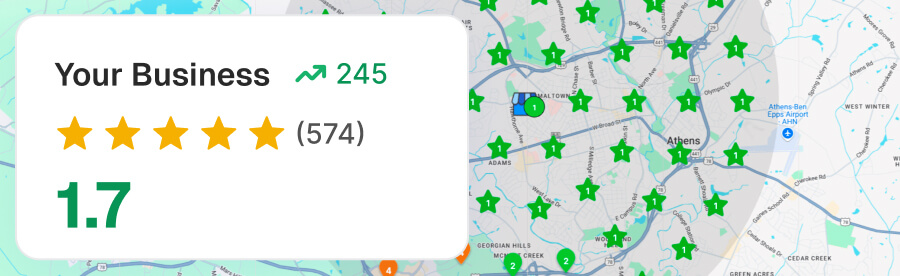
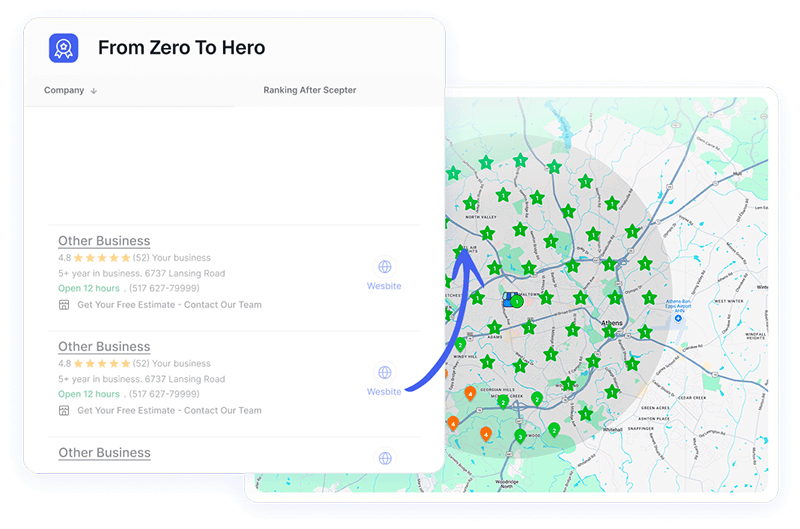
Our local SEO results page holds 99 map grids from 30 Business Profiles we manage. No grid drops under 60% top-three coverage, and 28 of them show the listing in the top three everywhere it was checked.
The Plan
Business names are blurred deliberately, since most belong to customers of agencies that resell our SEO, and the page is a selection rather than our full client list.


Problem
One retail group, several ecommerce and catalog sites, no shared standard. Specs and prices didn't line up between sites, and downtime kept landing in the busiest traffic stretches.
The Plan
That group's product data now lives in one cleaner structure, so a price or spec reads the same on every store, and the busy-season outages are gone. Details are on our case studies page.
The Plan
Picture a Holland furniture supplier whose specs sit in three spreadsheets: same problem, smaller scale. Work like that is part of our statewide Michigan web design practice, and we also build for Wyoming businesses, about 22 miles from Holland. If search traffic is already arriving, add Holland SEO to the rebuild so those visitors reach pages designed to produce inquiries.


Problem
What the evidence doesn't show: your market. The grids are a selection, map positions move, and none of it predicts where a Holland business will land.
The Plan
So check it yourself. Open the results page and the case studies, zoom into the grid points, then run your own site through the free check.
The Plan
If it holds up, we talk scope. If it doesn't, you've spent ten minutes on it, not a deposit.
Five builds from our case studies page. Each card covers what we did, what changed and the lesson for a Holland business, without claiming any were built here.
We built a Shopify store and automated it in under two weeks. A Holland farm business selling direct online could start lean like that, then add products.
A retail group's sites now share a cleaner catalog structure, matching specs and prices, and no downtime during peak traffic. For a Holland manufacturer with dealer sites, that consistency is the lesson.
We rebuilt a WordPress directory platform to handle thousands of listings. A Holland tourism site listing stays, tours or events runs into the same scaling question.
An author and publishing platform got faster load times and simpler navigation. Higher education is part of Holland's economy, and any site heavy with articles, programs or events benefits from that kind of cleanup.
Our outreach automation build took 80% of the outreach tasks off human hands. A Holland firm with a small sales team could apply the same idea to quote follow-ups.
The Shopify build shows a working store doesn't always need months. That's one past project, not a promise about yours, but a lean first version suits a seasonal Holland retailer testing online sales.
The retail overhaul centered on the data: one catalog structure, uniform specs and prices. If you run a parent brand plus product or location sites, that's where to start too.
The directory rebuild had to stay usable at thousands of listings. A Holland business with a long parts or product list faces the same test: can a buyer find the one item they came for?
The author platform overhaul delivered faster loads and simpler menus. If your Holland site holds years of articles, programs or archives, those two fixes come first.
The outreach automation build handled 80% of the outreach tasks automatically. A site that captures leads does half the job. Following up on them is the half that eats a small team's week.
You're a fit if your Holland business sells past the city limits, to customers in Grand Rapids, across Allegan County or anywhere in West Michigan, and your current site isn't earning its share of that work. If a small repair would solve it, you'll hear that from us before any talk of a rebuild.

Worth knowing. Builds move best when the owner can name the one result they want, like more quote requests or online orders, and can get us content and decisions without long gaps.

Our honest take. A website is sales equipment. Buying the cheapest one is like buying the cheapest press brake: fine until the work gets serious, and then you're shopping again, this time with lost jobs on the bill.
These are the questions that usually come up before anyone hires a web designer: price, pace, template versus custom, phones, and redesign timing. Got a question that isn't on the list? Send it. Whoever would build your site is the one who answers.
Price for a Holland site follows four levers: how many pages, whether we write the words, whether it takes orders online, and what it must hook into. A downtown storefront with five pages is a small job. A manufacturer needing dozens of capability pages plus an RFQ form that feeds its CRM is a much bigger one, and it's priced that way. Expect a written quote once we've had a scoping call, reviewed your existing site and agreed on the new one's job. No rate card, no guessing.
For an Ottawa County business, the schedule depends mostly on three inputs: whether your copy and photos are ready, how many review rounds you want, and how many outside tools the site has to connect to. Waiting on content is the usual holdup. Every connection, say a quote form feeding a CRM, needs testing on both ends. For scale, one Shopify build in our case studies was finished and automated before the end of its second week. That's one job, not a promise for yours. After the scoping call you get a calendar built around your page count and how fast you can review drafts.
A template works for plenty of Ottawa County businesses: a new service company with four or five pages and no plans to sell online can do fine on one. Custom earns its cost when the site has to carry more, such as a product catalog, a quote form that takes drawings, or separate pages for industrial buyers and local customers. It also matters if you work both sides of the county line into Allegan County and want pages built for each. Our case studies show both ends: a lean Shopify store and a multi-site catalog overhaul. We'll tell you which one fits.
That's how we build. Every site we build is laid out for a phone before a desktop, tested on both, and kept light so pages open quickly on cellular data. Light means compressed images, few plugins, no autoplay video on the homepage, and spec sheets as web pages rather than heavy downloads. That matters whether the reader is a visitor downtown or a purchasing manager between meetings. We also keep the tap-to-call number and the form within easy reach.
Responsive design means one site that rearranges itself for whatever screen opens it, from a phone to a wide office monitor, with no separate mobile version to maintain. Columns stack, menus fold into a button, images resize, and text stays readable without zooming. It matters because a Holland business often hears from more than one kind of visitor. An engineer may review your capabilities on a desktop at work, then pull up the same page on a phone to call you from the floor. Google also indexes the mobile version of a site first, so a layout that breaks on phones hurts more than looks. We build every page responsive by default.
Redesign when the site stops doing its job, not when a set number of years has passed. The signs are practical: it looks wrong on a phone, it can't hold the products or services you've added, inquiries have dropped off, or your team has quit updating it because editing is painful. If the site predates your current product lines, it's probably overdue. Not sure where yours stands? Run it through the See How Your Site Measures Up tool or the free AI Visibility Check. Both show what's holding it back, and we'll say whether a refresh or a rebuild makes more sense.
Search Console recorded 108 impressions for “internet marketing holland mi” and 76 for “marketing holland mi” over six months, listed beside the web design queries. So here are the add-ons that sit naturally with a build. Run our AI Visibility Check (it's free) and it'll suggest which one comes first.
Want more than a website? Our digital marketing in Holland page handles the wider marketing picture. If you also sell to customers in Walker, about 24 miles away, see Walker web design.

We handle on-page SEO, content and Google Business Profile management on the structure we built, aimed at regional searches like “web design west michigan” (13 impressions on this page in six months) and Holland ones. The grids on our results page show what that work looks like.

Steady reviews that describe real work give a stranger from out of town something concrete to weigh before they reach out.

Ads can put the new site in front of searchers now, since SEO takes time to build. You set the budget, and the tracking shows what each dollar brought.
Too Busy to Dive In?Only have a minute? Paste your homepage address into our AI Visibility Check, which is free. You'll get a short report on what Google's results and AI assistants pick up about your business, the speed of your pages, and which few repairs would likely bring in more Holland inquiries first.