


By Matt Hall, Founder, Scepter Marketing
Clarkston covers 0.44 square miles of land, the smallest city by land area in Michigan, so nearly everyone who could hire a Clarkston business lives outside it. Some are in Independence Township, which surrounds the city entirely. Others are in Waterford, about 5 miles away.
We tune your Google profile and your site so you turn up for those people too, not only for the handful of searches typed inside city limits.
Scepter Marketing does SEO for Clarkston businesses, and the plan starts from an odd map fact. Clarkston is the smallest city in Michigan by land area, a little under half a square mile, with Independence Township around it on every side. Ranking for every search inside those limits would still reach few buyers. So we point your listing and pages at the township and the rest of Oakland County, where most of your potential customers live.
Waiting has a cost when buyers are already searching. When someone near the city types the service you sell, Google picks three businesses for the map, and the rest of the page fills with whoever explained themselves better. None of that pauses while you decide. The longer a rival's listing keeps collecting reviews, the wider the gap gets.
Be found by the households around the city line, since so few sit inside it.
Every corrected category and fresh review adds to the last one. Nothing resets.
A listing people see more often gets more chances at the phone call.
Google weighs distance on every map search, and that works against a Clarkston pin more than most. The city holds 0.44 square miles of land and is surrounded by Independence Township, so a homeowner out in the township can easily sit closer to three rivals than to you. Being somewhere on page one doesn't fix that. What closes the gap is everything other than distance: a primary category that names your actual job, a service area set to the places you really drive, pages that describe work in those places, and reviews from customers who live there. A listing with those pieces can show for searchers who aren't on its doorstep. One without them tends to win only the few blocks around the pin, and in Clarkston that's very few blocks.
Google Ads can put you at the top of the page this afternoon, and for a new service that's often a sensible start. The catch is the meter. Every click costs money, and the spot is gone once the budget runs out. Earned work leaves something behind instead: a corrected profile, pages that keep describing your services, reviews that keep counting. None of that switches off at the end of a month. For a Clarkston business there's a second cost to ads alone. Because most customers live outside the city, your ads have to reach well past the city line, and every one of those wider clicks is paid for. Plenty of owners run a modest ad budget while the earned side catches up, then use actual call numbers to decide what to keep.
Money is rarely the difference. Listings that tend to hold map spots have said, plainly and in more than one place, what they do and which towns they work in. Their primary category fits the search word for word. Their service area includes the places their calls actually come from. New reviews show up most months, and some describe the work and the town it happened in. Their site gives each service its own page with real detail. For a business here, the geography piece outweighs the rest. The 2020 census counted 928 people in the city, so the customers who keep you open are mostly outside it, in the township and in places like Waterford, about 5 miles away, or Ortonville, about 8. A profile built only around the city limits speaks to a sliver of that. We tune your listing and pages so Google can tie you to the larger area, then keep reviews and updates moving so the signal stays current.

Fast to switch on. But the spot is rented, and the phone goes quiet when payments end.

Recommended

We'd rather show than claim. Ranking grids from listings we manage are posted on our results page for anyone to read. The audit software behind the AI Visibility Check is something we built and run in-house. And when we explain a fix, we explain it so you could check it yourself.
O1

Each task we propose comes with a plain reason it helps a business whose buyers mostly sit outside a 0.44-square-mile city, plus the measure we'll watch to see if it worked. If we can't explain a job in two sentences, it doesn't go on your invoice.
O2

Your questions go to the people doing the work on your listing and site, not to a relay. Before anything changes on your site, you hear about it first.
O3

Rankings tell us whether the work is landing. Calls, form leads, and direction requests tell you whether it's paying. We report both, and we're clear about which one matters to your bank account.
O4

We never buy links or use private networks. We pursue mentions your business can earn on its own, such as features from groups you already belong to.
O1

Start with the city and the township around it. Adding more surrounding towns later reuses the same profile setup and page format, so each new area takes less effort than the first.
We put our own site through the same audits we sell. Clients get that standard too.

Founder at Scepter Marketing
For a Clarkston business we start wide. First we decide which surrounding areas deserve attention, then audit the site, set up the Business Profile for that coverage, write pages for those areas and services, and report what changed. The area decision comes first because every later step depends on it.

We look at where your jobs actually come from, then at who Google shows for your service in those places. That tells us which areas get pages first.

The output is a short written plan listing each area, the services that matter there, and what we'll change first. You can share it with your staff so everyone knows what customers outside the city will start seeing.
01
02

Our audit engine crawls your site the way a search tool would, then sorts every problem by how much it's likely costing you. Titles, headings, internal links, and broken pages all go on the list.

Duplicate pages get merged, thin ones get filled out, and titles start naming both the service and the area served. Those changes tend to be among the first things Google picks up.

We write a page for each core service and for each surrounding area you want to win. Each one is written for someone outside the city who has never heard of you.

An area page earns its place only by telling the truth about work in that place: which jobs you take, how far you travel, what happens after someone reaches out. Each one ends with a phone number a mobile visitor can tap in one move.
03
04

Slow templates, crawl errors, sitemap conflicts, and redirect chains all get fixed. We clear the same kinds of problems on our own site.

It's dull work, and we do it on our own pages too. A site Google can crawl cleanly lets every page you add pull its full weight, instead of fighting old errors.

We pick categories that match your real jobs, list your services, set the service area, and make your business details match across directories.

Distance stays fixed, so these settings carry more weight for a city address with so little ground around the pin. Reviews from surrounding customers add to it.
05
06

Each month we send ranking grids for your service across the areas you chose, plus calls, form leads, and listing actions. Changes are explained in plain sentences.
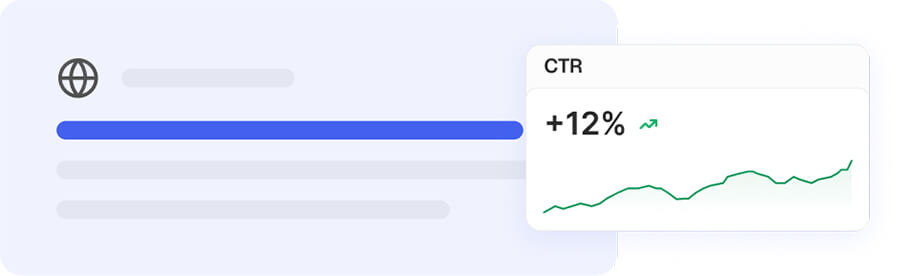
Grids are a gauge. What counts is whether the phone rang more from the township this month. If a page sits idle, the report says it plainly and we shift hours toward the pages bringing in work.
Here's what the monthly work contains, written for a business whose customers mostly live beyond the city line. No mystery line items. If a piece doesn't apply to you, we leave it out.
What we do
Titles, headings, and page copy get rewritten to name your services and the areas you cover, so a searcher outside the city sees right away that you serve them.
Why it works
Someone in the township picking from ten results chooses the one that plainly answers their search. A title naming their area and your service gives them that answer.
Where it shows up
This is where you'd look for it: click rates on searches you already appear for, and steadier positions for service searches around the city.
What we do
We speed up slow pages, remove broken and duplicate URLs, clean the sitemap, and check that each page renders correctly for Google, phones included.
Why it works
A small business site with a few hundred pages can hide errors nobody on staff ever notices. Google notices them. Clearing them lets crawl time go to the pages that describe your work.
Where it shows up
Watch your crawl reports in Search Console: fewer excluded pages, faster load scores, fewer surprises after a Google update.
What we do
Links come from places with a reason to know you: trade associations, a youth team sponsorship, a local news story, a supplier's dealer page. Each points to the page it fits.
Why it works
Google discounts links it can tell were bought. Earned mentions keep their value through updates, and they bring real referrals.
Where it shows up
Look for it across the whole site, not just on the page that earned the link.
What we do
We write service pages and area pages for the places beyond the city where your customers live, plus articles answering the questions they ask before they call.
Why it works
A page that answers the real question gives people a reason to call. Thin area pages with a town name swapped in do the opposite, and searchers notice quickly.
Where it shows up
This shows up in Search Console as queries pairing your service with surrounding areas, and in calls from those area pages.
What we do
We fill out your Google Business Profile properly, from categories and services to service area, description and photos. We correct your name, address and phone in the directories and hand you a short after-the-job habit for asking for reviews.
Why it works
For local trades the map is often where the first call comes from. With a Clarkston pin, the profile has to work harder on relevance and reviews to reach searchers farther out.
Where it shows up
Fewer guesses: Business Profile insights show views, calls, site visits and direction taps, and the searches people used to find you.
What we do
Every month: grid snapshots across your chosen areas, calls and forms, Business Profile activity, and notes on what we tested.
Why it works
You can read it in five minutes and know where things stand.
Where it shows up
Spending choices made from real numbers each month.
Three factors drive the map pack. Relevance: does your listing describe the service the person typed? Distance: how near your pin sits to wherever they're standing. Prominence: what the web says about you, mostly through reviews, links and mentions on other sites. A Clarkston address only helps with distance inside a tiny footprint.

Query match alignment.

Reputation & Authority.

To the searcher.
Take a Clarkston contractor whose pin sits in a city of less than half a square mile. Someone in Davisburg, about 6 miles off, searches for that trade. Distance favors any business nearer to Davisburg, and no amount of work relocates a pin. That leaves relevance and prominence. Relevance means a primary category naming the trade precisely, services written the way customers phrase them, and a site page about work in Davisburg with genuine detail. Prominence means reviews that keep arriving, a few from people in that area, plus mentions from groups around the county. None of that guarantees a win over a contractor next door to the searcher. It does give Google a credible reason to show a Clarkston listing several miles out, and that matters, because several miles out is where most of a tiny city's customers are.
SEO still matters here, because AI assistants and Google's AI summaries write their replies from pages, listings and reviews already sitting on the web. Say a resident of Independence Township asks a chatbot who handles your trade close by. A thin website and a half-filled profile give the tool nothing to quote about you, so it quotes a rival with more on record.
The AI Visibility Check is free and uses the audit software we built. It looks for your business in Google and in AI assistants on the searches tied to your work, then lists the gaps: missing service details, area coverage your listing doesn't claim, and pages those tools can't use.
We have no Clarkston client to show, and we won't present outside work as local. Below is a slice of our Maps record from listings we handle, names withheld, plus the founder experience behind it.


Problem
A map ranking can look great from the owner's desk and poor two miles away. One search proves nothing.
The Plan
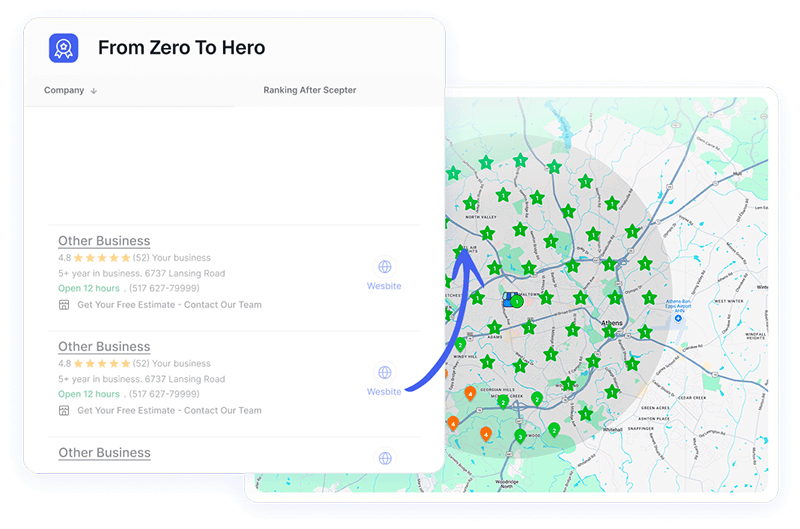
Our results page carries 99 grids of Maps rankings, drawn from 30 Business Profiles we manage. Each shows the listing top three across 60% or more of points.
The Plan
Twenty-eight of those grids stay green at every point checked. Names are blanked because most listings belong to agencies' clients, and the page is a selection, not everyone.


Problem
Most owners can't tell whether their site has problems Google cares about, and generic scanners bury the few that matter.
The Plan
The AI Visibility Check, and the audits we run for prospects, come from audit software we built and maintain ourselves.
The Plan
Matt Hall founded our agency and has done search work since around 2009. His years in the trade shape every audit and the Michigan SEO work we take on.


Problem
Our own site had built up years of broken legacy images and redirects that no longer pointed anywhere useful.
The Plan
One audit wave in 2026 restored 167 images and cleared 141 redirect issues across the site.
The Plan
Doing it on our own site keeps us honest about what this work involves before we quote it for yours.
You're probably a fit if your address says Clarkston but your customers come from across Independence Township and beyond. That covers roofers, remodelers and other trades who travel to the job, salons and gyms people drive to, and accountants or insurance agents whose clients are spread around the county. If you only need one piece, say the profile or the site, we'll scope that alone.

Why this matters. Two inputs only you can supply: reviews from the people you've served, and the real details of what you sell and how far you'll travel. We handle the listing and the writing. When those two keep coming, everything we build has firmer footing.

Why this matters. Cheap SEO usually means bought links or copied area pages, and both can leave you worse off than before. Turning down the wrong fit early saves you money and saves us from a project neither side enjoys.
These are the questions owners ask before hiring anyone for SEO in Clarkston. The answers below are short and direct, and each one accounts for the main quirk of this market: a very small city whose businesses depend on customers from the township and towns around it.
It depends mainly on how many surrounding areas you want to cover, and we price it after a free check rather than from a menu. For a Clarkston business that's the biggest driver, because the city alone is too small to be the whole target. Every added area means more page writing, more listing work, and more grid tracking. Two other factors matter: how many businesses in your trade compete across those areas, and how much repair your current site needs. Start with the free AI Visibility Check. The quote follows from its findings and the coverage you pick.
No one can honestly promise a date, but the sequence is predictable. Business Profile corrections and grid shifts close to your address tend to appear first. Reaching searchers across Independence Township and beyond takes longer, because it depends on content and reviews piling up, and on how many rivals in your trade already work those searches.
You almost certainly need both, and here the website pages carry more weight than they do in most towns. Local SEO covers the map: your Business Profile, your reviews and your rankings near your pin. Regular SEO is your site showing in the standard results. Distance drives the map, and a Clarkston pin covers very little ground, so a homeowner in Ortonville, about 8 miles away, is more likely to reach you through an organic page about jobs there than through Maps. We set up the profile for searchers close by and build pages for the ones farther out.
Yes, in most cases, as long as the goal is the township around you rather than the city alone. Searches naming the city can be few: for our own trade, Google Ads reports about 10 searches a month for "seo clarkston mi". The bigger opening is people across Independence Township searching for your trade, and our AI Visibility Check shows whether you come up for them.
You'll know by whether calls and form leads climb, and that matters more than any position. Monthly, we send ranking grids like the ones on our results page, along with Business Profile activity: calls, website clicks, direction requests. For an address this small, the grids show whether you appear past city limits. Green grids with a quiet phone mean we go back through the site and profile to find the leak.
It's a no-cost scan that asks Google and AI assistants about your type of business and reports whether yours gets named. Our own audit engine runs it. For a Clarkston listing, we also look at how well your profile and site describe the township around the city, since most of your callers likely come from there.
SEO gets people to your listing and site. What happens next depends on the site, the reviews, and whether you need calls before rankings arrive. These three are the services most often paired with SEO for businesses selling into the area around Clarkston.
SEO is one of several things we do here. There's wider digital marketing for Clarkston and Clarkston web design. If you also serve neighboring markets, see Davisburg SEO (about 6 miles away), White Lake search work (about 7 miles), our Ortonville SEO page (about 8 miles) and Union Lake SEO (about 8 miles).

Area pages only help if the site under them loads fast and works on a phone. We build and rebuild sites with that structure in mind, so new area pages slot in cleanly.

Of the three map signals, prominence is the one your own customers can move. When people from the towns around you leave a review that describes the work, Google gets another reason to show your listing there.

Ads let you target the surrounding areas right away, which helps while organic pages are new. Once those pages start producing calls, you can trim the ad spend area by area.
Too Busy to Dive In?If you only do one thing today, run the free AI Visibility Check. Enter your site and we'll show what Google and AI tools say about your business, and which fixes would help most for reaching customers beyond the city line.