


By Matt Hall, Founder, Scepter Marketing
Yes, Scepter Marketing does digital marketing in Burton, MI, for local businesses that want the phone to ring more. In practice that means your Google Business Profile, your website, local SEO, reviews and, where it makes sense, Google Ads, run as one program by one team. Burton covers more than 23 square miles of land, so being found on your own street isn't the same as being found across the city.
We measure that spread with Google Maps ranking grids, fix what keeps your listing from reaching the other side of town, and count the calls that come out of it. Then we tell you plainly what moved and what didn't.
Scepter Marketing takes on digital marketing for Burton businesses, and day to day that means more calls you can trace to a source. The catch here is size: a Burton profile pinned near one end of town may fade in Maps for a searcher at the other end.
Picture someone in Burton with a furnace that quit. They open Maps, tap the first listing that looks close, check the website for the service they need, then skim the reviews. Three channels, one decision in a few minutes. If any one of them is weak, the call goes to the next listing.
Your profile has to appear for that searcher, wherever in Burton they're standing, before anything else can work.
A clear page that names the service and the area keeps the visitor from backing out to the next result.
Recent reviews that mention real jobs give a first-time Burton customer enough confidence to dial.
Say your Maps listing is in good shape and someone across Burton taps it. The profile sends them to a homepage that doesn't mention the repair they searched for, loads slowly on a phone, and buries the number. They go back and tap the next listing. Your SEO vendor sees a click. Your web person sees a visit. Nobody sees a lost call, because nobody owns the whole path. That gap opens easily when channels are bought one at a time. Each vendor reports on its own piece, and each piece can look fine on paper while the sequence breaks at the handoff. We look at the path the way the customer walks it: listing, page, reviews, phone. When one team fixes all four, the weak link gets found instead of argued about. That's the practical case for one plan.
A Burton business can pay someone to tune the Google profile and stop there. It's a reasonable first move. The trouble is distance. A profile can only stretch so far from its pin on its own, and Burton is a wide city with Flint about 4 miles away. Reaching customers across that spread usually takes more than the listing: service pages that name the work, location signals on the site, and steady reviews. Buy only the profile and you've paid for one link in that chain.
Ads are the other common single purchase. They put you on screen right away, which is useful, but they stop the day the budget stops. And an ad that lands on a weak page wastes the click you paid for. Run alongside a profile that's been built out and a site that answers the question, ads become a way to cover the stretches of Burton where Maps isn't reaching yet, rather than a permanent patch over it.
Burton is the second largest city in Genesee County, with about 29,700 people at the 2020 census. That size matters for a local business. Your customers may live a few miles from your door and still sit outside the area where your listing shows up well. Some of them may also be weighing businesses from nearby cities alongside you. So the plan starts with a map, literally: we check where you appear across the ground you want to work, then decide which channel closes each gap. Sometimes that's the profile. Sometimes it's a service page or a review push. Occasionally it's ads.

You can run the profile yourself. Few owners have time to also track calls, write service pages, and check Maps coverage across Burton every month.

Each piece may be handled fine. Nobody watches the handoff from listing to page to phone, so lost calls never show up anywhere.
Recommended

Your listing, pages, reviews and ads handled by one team, checked with ranking grids, and judged by tracked calls from Burton customers.
We publish our Google Maps ranking grids openly, so you can judge our Maps work before you hire us. Behind that sit one team on every channel and a Michigan-based crew keeping U.S. business hours at our East Lansing office.
O1

You'll hear what we're changing in words you'd use yourself. If we move a category on your profile or rewrite a service page, the note says what changed, why it should help a Burton customer find you, and how we'll check it.
O2

We're based in Michigan and keep U.S. business hours. Your questions go to the people doing the work, during the hours you're open, with no overnight handoff to another time zone.
O3

Our results page holds 99 Maps ranking grids from 30 profiles we manage. Each shows the business in Google's top 3 at 60% or more of the points checked. We don't present any of them as Burton businesses.
O4

Your profile, site, reviews and ads sit with one team. If Maps coverage thins out on the far side of Burton, nobody can blame the web vendor or the ad vendor, because there isn't one. We own the fix.
O1

Begin with the listing and a couple of service pages if that's what the budget allows. When you're ready to reach farther into Genesee County, we add channels on top of the same call tracking, so the history carries over.
I've been doing this work since about 2009. Our ranking grids are public, with business names hidden, so an owner can look at the work before talking to us.

Founder at Scepter Marketing
Here's the order we'd follow for a hypothetical Burton heating and cooling contractor, picked as an example because the business type makes the spread problem easy to see. Same steps for any trade: audit, fix the foundation, build Maps and search coverage, add paid only where the numbers hold up, then report on calls.

We run a ranking grid across Burton and the surrounding area, read your profile and site, and use our own audit engine to see how search and AI tools read you.

For the example contractor, the audit might find a strong grid near the shop and pale points toward the far edge of the city, a profile with one generic category, no page for furnace repair, and no record of how many calls Maps sent. Each finding gets a channel and an owner, written down so nothing drifts.
01
02

Before anything changes, we put tracking numbers on the profile, the site and any ads, and capture forms, so the next audit can show what each fix actually did.

Tracking first sounds backwards when the grid already shows gaps. It isn't. If we fix the profile and the calls rise, you want to know it was the profile and not a cold week. Separate numbers for Maps, the website and ads let us answer that. Forms get tagged the same way. We also fix the dull technical problems here, like broken images, bad redirects and slow pages. We hold our own site to the same standard: one 2026 pass there cleared 167 broken images and 141 redirect problems.

This is the Maps and SEO step. Categories and services on the profile get corrected, a page goes up for each main job, the site states where you work, and reviews get requested after finished jobs.

Then paid search, but only if it earns a place. For the example contractor, ads could cover the grid points where Maps stays pale while the organic work catches up. If the tracked calls from ads cost more than the job is worth, we say so and turn them down. Nothing here is switched on because a package includes it. Each channel has to show up in the call log.
03
04

We rerun the grid on a schedule and compare it with the last one, point by point. Spots that turned green stay on watch. Spots still pale get the next fix.

The grid tells us where you appear. The call log tells us whether appearing there mattered. We need both. A point on the far side of Burton might turn green and send nothing, while a smaller gain near the shop brings real jobs. So budget and effort move toward the parts of the map that produce calls, and we stop polishing points that don't.

Each month you get the call and form counts by source, the latest grid next to the previous one, what we spent effort on, and what's on the list next.

Rankings go in the report, but they aren't the headline. A report that leads with keyword positions can look great in a month when the phone was quiet. Ours leads with calls, then explains them with the grid. If something we tried didn't work, it's in there too, with what we think went wrong. You shouldn't need us on the phone to understand your own report. Read it in five minutes, ask whatever's unclear, and decide what to keep.
05
06

When a channel keeps producing tracked calls at a price you're comfortable with, we give it more room, whether that's a new service page or a wider reach into Genesee County.
Growth here usually means geography or services. Geography: pushing grid coverage from the Burton side toward the next towns your crews already drive to. Services: adding pages and ad groups for jobs you want more of, like replacements over repairs. Either way the tracking is already in place, so each expansion gets judged on calls from the start instead of on hope.
Search numbers for these phrases are close to zero. Google's keyword data shows no volume for “burton mi digital marketing” or “digital marketing company burton mi”, and Search Console shows a single impression for “digital marketing agency burton” over six months, at position 4 with no clicks. We don't chase that phrase. The work below is aimed at the jobs you sell, and each item says what it fixes.
What we do
We work the ranking signals that affect how far your listing reaches: profile categories and services, location pages on your site, and consistent business details across directories, so a Burton search from across town can still surface you.
Why it works
It fixes the edge problem. A listing pinned at one address in a city of more than 23 square miles tends to weaken with distance. Building those signals gives Google more evidence that you serve the whole city, not one corner.
Where it shows up
On the ranking grid. Before and after, you see which points around Burton moved into the top 3 and which didn't, then the call log shows whether those points sent business.
What we do
We build search campaigns around specific jobs, send each ad to the page for that job, and put a tracking number on every one.
Why it works
Ads fix a timing problem and a reach problem. They show you on parts of the map where your listing isn't strong yet, and they don't wait on organic work. The trade-off is plain: they cost money every day they run.
Where it shows up
In the call log, split by campaign. Search terms that bring calls get more budget. Terms that bring clicks and silence get cut.
What we do
We keep your Google Business Profile current, with hours, photos, services and posts, and set up a simple way to ask finished customers for a review while the job is fresh.
Why it works
It fixes the moment after someone finds you. A Burton customer comparing three listings will read what others wrote. A profile with stale hours or reviews that stopped arriving a year ago gives them a reason to keep scrolling, even if you rank first.
Where it shows up
In profile insights and the call log: calls placed from the listing, direction requests, and how review volume trends over time.
What we do
We write a page for each job you want more of, plus a location page explaining where in and around Burton you work, in plain language a customer would use.
Why it works
Pages fix the gap between being found and being chosen. A visitor who searched for a specific repair and lands on a generic homepage may leave. A page that names the repair, the area and the obvious questions keeps them reading.
Where it shows up
In Search Console impressions for service terms, in visits to each page, and in the forms and calls those pages generate, tracked separately from the homepage.
What we do
We assign separate tracking numbers to the profile, website and ads, record calls where you want that, and tag form submissions, all feeding into one place you can read.
Why it works
It fixes guessing. Without it, a busy month gets credited to whatever you changed last. With it, you know whether Maps, the site or the ads actually sent the work.
Where it shows up
In a call log you can sort by source, and in the monthly report, where each channel's cost sits next to the calls and forms it produced.
What we do
A short monthly write-up covering tracked leads by channel, grid changes around Burton, what we worked on, and the next priority.
Why it works
It fixes the trust gap with vendors. You see the same numbers we see, including the months where something underperformed.
Where it shows up
In your inbox each month, readable in a few minutes, with every number traceable back to a call, a form or a grid point.
Burton covers about 23.4 square miles of land, and a Maps listing is pinned to one point. A customer searching from the other end of the city may see a different top 3 than one searching near your shop. That distance is the Burton problem.

Reach beyond your own corner.

Reviews that look current.

Profile, pages and reviews fixed together, measured by grid.
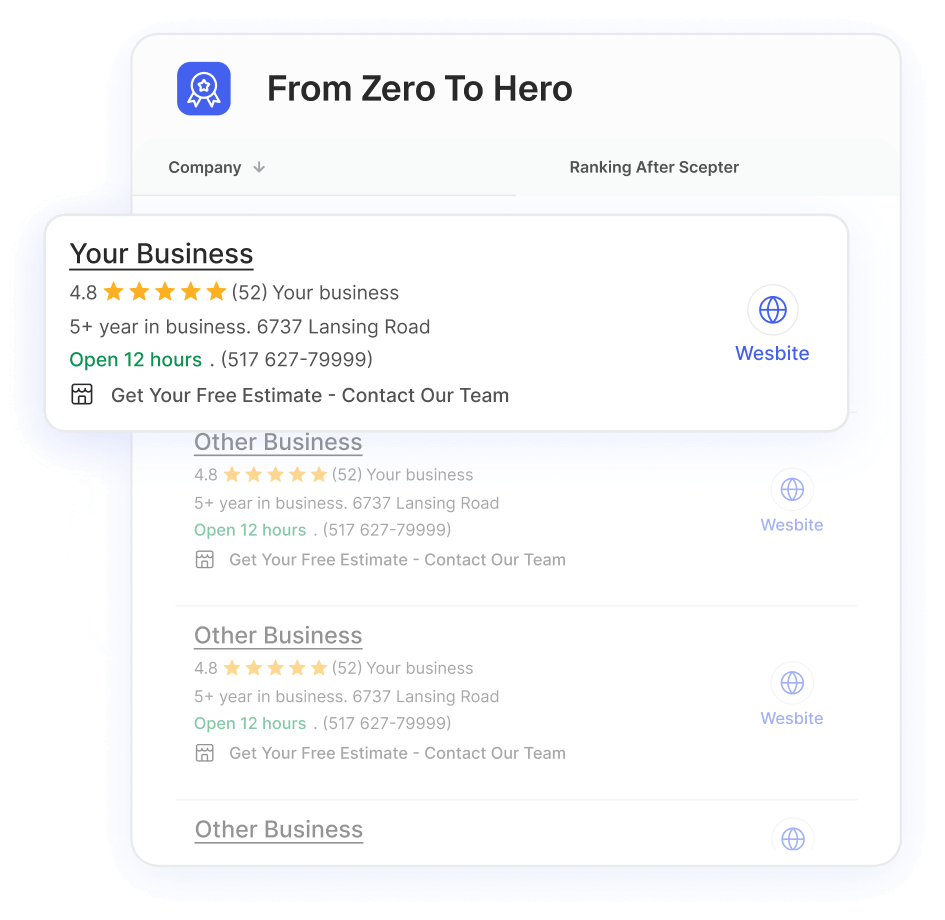
The fix starts with measuring the problem instead of guessing at it. A ranking grid checks your position at points spread across Burton and beyond, so you can see exactly where the listing fades. From there the work is specific: categories and services that match what you do, a site that states the areas you cover, service pages that give Google something to match, and reviews coming in steadily. Then we run the grid again and compare. Burton also sits about 4 miles from Flint, so if Flint customers matter to you, the same grid can include them. We won't promise any point turns green; the grid shows whether it did.
Someone in Burton might type into ChatGPT: “Who's a reliable furnace repair company near Burton, Michigan that can come out this week?” The assistant builds its answer from what it can find and cross-check: business listings with matching details, reviews, and websites that answer the question in plain sentences. Google also showed an AI Overview for “digital marketing company burton mi” when searched from inside the city.
None of that can be bought directly, and we won't promise a mention. What helps is the same groundwork as Maps: consistent details, current reviews, clear service pages. The Free AI Visibility Check is built on the audit engine we run ourselves; it reports how your business currently comes across to search and AI tools and which gap to close first.
Two things to look for before hiring any agency for a Burton business, ours included: proof you can open and inspect, and evidence the agency does the work it sells. Here's ours. We don't present any of it as Burton work, and we'd rather say that up front than let you assume it.


Problem
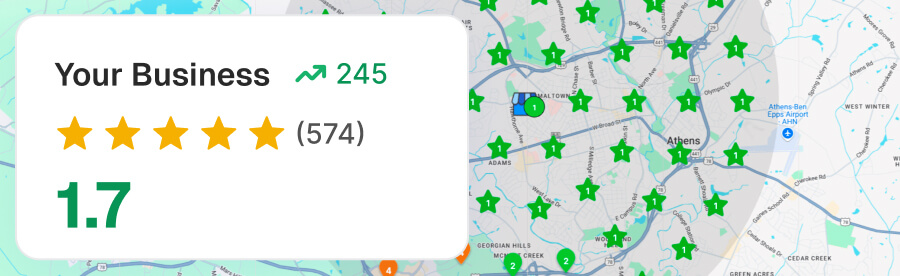
A single Maps search from one spot tells you little. Your position changes with where the searcher stands, and a city as wide as Burton magnifies that.
The Plan
We run ranking grids for the Google Business Profiles we manage, checking position at many points around each business.
The Plan
Our results page shows 99 of those grids across 30 profiles, every one in Google's top 3 at 60% or more of its points.


Problem
Our own website had built up old technical debt: legacy images that no longer loaded and redirects that had gone wrong.
The Plan
We treated it like a client audit. One 2026 audit wave restored 167 broken images and cleared 141 redirect problems, the same unglamorous work we'd do on your site.
The Plan
Burton is one of the Michigan cities covered by our statewide digital marketing work. If your main goal is ranking in Google for the jobs you sell, our SEO page for Burton goes deeper on that side. Technical cleanup like the one above often comes first, since pages that break or redirect badly make every other channel work harder.


Problem
Partial visibility is easy to miss. A business can look fine near its own address and be nearly absent a few miles out, and nobody notices without measuring.
The Plan
Of the 99 grids on our results page, 28 show the business green, meaning top 3, at every single point checked. The rest reach the top 3 at 60% or more.
The Plan
Business names are blanked out, since most belong to customers of agencies reselling our work. The page is a chosen sample, not our full client list.
This fits Burton businesses whose customers come to them, or who drive to customers, across a spread-out area: trades, repair services, auto shops, and local retail with a service counter. It fits best when you suspect your Maps listing works near the shop and fades farther out. If all you need is a new website, say so, and we'll scope only that.

Why these fit. These are businesses where listing, website and reviews together decide who gets the call. That chain is exactly what we work on, and a ranking grid can measure its first link at points across Burton.

Why we say no. Everything we do is measured against grids and calls. A guarantee would be dishonest, since Google decides placement. Without tracking, we couldn't show you whether the work paid off, and you'd have no reason to keep paying for it. Referral-only businesses with a full schedule may simply not need us, and that's a fine place to be.
Short answers below for Burton owners sizing up an agency. Each one starts with the direct reply, then explains how it applies in a city as spread out as Burton. Where we don't have a number to give, like a price, we say so instead of inventing one.
There's no fixed Burton price, and we won't guess at one here. Cost depends on how many channels you need, whether ads are involved (the ad spend itself is separate from our management), how much the website needs before anything else can work, and how far you want to reach. A shop content with coverage near its address needs less work than one trying to show up across all 23-plus square miles of Burton and beyond. The audit is how we scope it: we study the grid, the site and the profile, then price the work that's actually needed.
We can't give you a date, because Google sets the pace. What we can say is which parts tend to move faster. Profile fixes, like correcting categories or adding services, are quick to make, and Google can pick them up sooner than new content. Service pages and broader SEO take longer to earn ground. Ads run the day they launch, but you pay for every click. In Burton the slower part is often distance: pushing your Maps reach toward the far side of town takes more than one change. Rerunning the grid shows you, point by point, how far it has come.
For a Burton business, we'd handle the chain that turns a local search into a call: the Google Business Profile, local SEO, service pages on your site, reviews, tracking, and Google Ads where they earn their spend. We'd also fix site problems that get in the way, from broken pages to slow loads. What we probably wouldn't push first is social media or broad content, since neither usually sits between a local search and a phone call. Everything is measured two ways: ranking grids show where you appear across Burton, and tracked calls show whether appearing there paid off. You get both in one monthly report.
A marketing funnel is the set of steps between someone noticing you and calling you, and yes, your Burton business already has one, even if nobody drew it. For most local service businesses it's short: a Maps result, a profile, a website page, a review or two, then the phone. Leaks tend to sit at the handoffs. The listing appears but the profile looks abandoned. The profile is fine but the website link goes to a page that never mentions the service. The page is good but the number is hard to find on a phone. We map your version of those steps, find where people drop off using tracking and the grid, and fix the weakest step first instead of buying more traffic to pour through a leak.
For most Burton businesses, not as the first spend. When you depend on local calls, social posts don't fix the problem this page is about, which is whether your listing shows up across a wide city. Profile work, service pages and reviews address that directly, and tracked ads can fill gaps. Social makes sense in a few cases: you sell something visual, like finished remodels or custom work; you already have an audience that engages; or you want a place to show recent jobs. If you do run it, we'd track it like everything else, with tagged links and form sources, so it has to show up in the call log to keep its budget.
It tells you how your business currently appears to Google and to AI assistants, and which gap is worth fixing first. It's free, it runs on the audit engine we built and use in real prospect audits, and there's no sales call required. For a Burton business, the useful part is seeing whether the basics line up: matching listing details across the web, a site that answers plain questions about your services and where you work, and reviews recent enough to matter. It won't predict whether ChatGPT names you. It shows what those tools have to work with.
Burton's size shapes which channels belong together. When customers come from all over a city this spread out, the pairing that matters most is Maps work with location-focused SEO, and ads get added only where the grid shows a stubborn gap.
We also build and fix sites, covered on our Burton web design page. If your customers reach beyond Burton, these nearby pages in our Michigan network show how we'd approach each place (straight-line distances): Flint, about 4 miles away; Ortonville and Holly, each about 14 miles; and Davisburg, about 17 miles out.

This pair handles the distance problem. The profile tells Google where you are and what you do; site pages for each job and area give it grounds to rank you farther out.

When certain points stay out of reach after the profile and pages are done, location-targeted ads can put you in front of those searchers while you pay for it.

Reviews pair with both. They help a Burton customer pick you once you appear, and recent ones count among the signals Google uses for local ranking.
Too Busy to Dive In?Not sure which pair fits? The free check is a quick place to start. Enter your website and you get a read on how search and AI tools see your business right now, plus the first gap worth closing. It takes a few minutes, and no call is needed.