


By Matt Hall, Founder, Scepter Marketing
Yes, Scepter Marketing does Bay City MI digital marketing, and we do it for owners who measure success by the phone. Maps, search, your website, ads and reviews get planned together and scored on calls. Bay City is the seat of Bay County, and its metro area covers the entire county, so a good share of your buyers probably live outside the city itself.
So we don't stop at the map pack around your address. We build reach across the county and over the bridges, track every call and form, and send you a plain-English summary each month that shows where each lead started.
Yep, our work is built for Bay City companies that want more calls from all over Bay County, not only from the streets around the front door. The first thing we'd check is whether your listing ranks well on one bank of the river and fades on the other.
Here's how a Bay County buyer often picks a contractor: a Maps search from home in one of the townships, a tap on the website, a scroll through the reviews, then a call or a pass. If those three pieces come from three vendors, nobody owns the moment the buyer decides. One plan means one team answers for all of it.
Your profile and service pages reach searchers out in the county's townships, not only the ones a few doors from your shop.
When a Maps searcher taps through, your site answers their question fast and gives them one clear way to call.
Fresh reviews that name the job and the town give a hesitant buyer the last push to dial.
Bay City has about 10 square miles of land, and the river runs right through it, with several bridges tying the east and west banks together. Google's Maps results weigh distance heavily. An east-bank listing can sit near the top for a searcher two streets over and drop out of sight for someone across the water or in a neighboring township. Owners tend to test from their own counter, spot their name up high, and call it handled. Meanwhile one vendor buys ad clicks on phrases another vendor already ranks for. Reviews go unanswered because each person figures it's somebody else's task. No one is watching the full map. Put the listing, pages, ads and review asks under one team, and each channel gets its own gap to close.
Doing it yourself can work for a while, especially if your jobs come from people who already know you. The trouble starts when you want buyers who don't. A single channel only covers what it covers. Maps alone favors searchers close to your address. Ads alone go quiet once you stop paying. A website alone waits for traffic it has no plan to earn. And without call tracking, you can't see which of those is carrying the load.
Run together, the pieces cover each other's blind spots. Ads can reach the township searcher your listing misses today. Pages aimed at the townships you cover give Maps and organic search more to work with. Reviews make the click worth it. And tracked numbers on every channel tell us where to move money next month. It costs more than doing one thing. It also stops you paying for overlap and for channels that quietly produce nothing.
As the county seat, Bay City is home to most of Bay County's agencies and associations. Its metro area covers exactly the same ground as the county, which sits inside the larger Greater Tri-Cities region, and Bay City forms the Tri-Cities with Saginaw and Midland. If you sell a service, your real customer base likely runs well past the 32,661 residents the 2020 census counted in town. Steady leads depend on being visible across that larger area and measuring it. Concretely, that means a Business Profile filled out and kept current, plus service pages and township pages for the areas you're after. Paid ads go only where organic reach runs out, and a review ask goes out once every job wraps up. Each call and form carries a tracked source. That changes the monthly question. You stop asking whether marketing worked and start asking which piece did, and where in the county.

Low cost up front. But it runs on your spare hours, and with nothing tracked you can't tell a slow month from a broken channel.

Fine near the shop. Thin everywhere else, and nobody's watching which calls it actually brings.
Recommended

Your listing, site, ads and review asks handled by one crew, and each call matched to what produced it.
Our Maps ranking grids are published, so you can look over the work before you ever call us. All your channels sit with one team, which means nobody is protecting a slice of your budget. We're a Michigan team working out of our East Lansing office, and we keep normal U.S. business hours.
O1

You'll get explanations in words you and your office manager already use. Every recommendation comes with three things: what we're running, why it suits a Bay County service business like yours, and the number we'll watch to judge it.
O2

We're Michigan-based and keep U.S. business hours. A question sent on a Tuesday morning lands with a person who works on your account, during the hours your shop is open.
O3

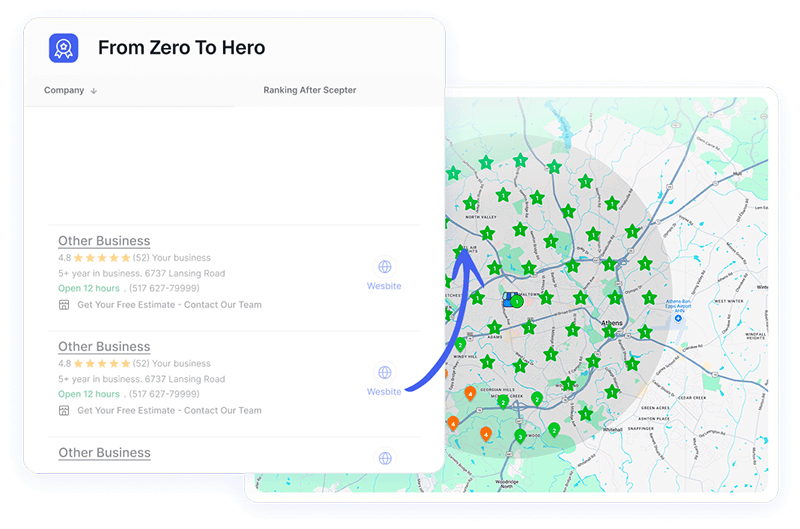
Our public results page holds 99 Maps grids drawn from 30 Google listings we look after. A grid tests ranking at many points across an area, which matters here, since Bay City spreads across both banks of the Saginaw River.
O4

Your listing, site, ads and reviews sit with one team. If calls dip in one part of Bay County, there's no debate over whose channel slipped. We read the tracked numbers and fix the piece that's short.
O1

Starting with one channel is fine. Plenty of owners begin with their Business Profile and add pages or ads later. When you want reach deeper into the Tri-Cities, the new work plugs into the tracking you already have.
“I've done this since about 2009. First I check where your listing stops showing up.”

Founder at Scepter Marketing
For a Bay City service company, the sequence stays fixed even if you start with a single channel. We audit what exists. We repair the base: profile, website and tracking. We build Maps and SEO reach across both banks and into the county. Ads come in only where the numbers justify them. Reporting each month centers on calls.

We run your site through our own audit engine, review your Business Profile, and grid your Maps visibility from the address outward, across the river and into the townships.

For a contractor on the east side, the audit might show strong placement near the shop, weak placement on the west bank, a site with one generic services page, and reviews that stopped coming a year ago. You'd get all of that in writing, with the fix we'd do first and the reason it comes first.
01
02

Tracked phone numbers on the profile, the site and any ads. Every form submission tagged by page. Without this, nothing that follows can be judged fairly.

This step comes before any new spend on purpose. If a call from a buyer in a bordering township comes through your Business Profile, we want to know that. If it comes from an ad, we want to know that too. Once each source has its own number and each form records its page, the later decisions about Maps, pages and ads rest on counts instead of opinions.

Then Maps and SEO: a complete, active profile, service pages that answer real questions, and pages for the parts of Bay County you want work from. Ads come later, and only where needed.

Ads are a tool for a specific gap. If the grid shows your listing fading across the river and the organic pages still need time, a tight campaign on high-intent service terms can cover that area while the rest catches up. If organic reach is already solid, we may tell you to hold the ad budget. We'd rather spend less on something tracked than more on something that isn't.
03
04

Every month we line up calls and forms against where they came from and which part of the county sent them. Budget and hours shift toward what's producing and away from what isn't, right then, not at a quarterly review.

For a Bay City business, the useful view is geographic. Are calls coming from the west bank now, or still only from the neighborhood around the shop? Are township searchers finding the new pages? We rerun the ranking grid to see whether reach changed, then read it next to the call log. Neither number alone tells the full story.

Each report shows your calls and forms, the source behind each one, what every channel cost, and the change we're making next month. It usually runs a page or two.

No vanity charts. If a channel had a weak month, the report says so and says what we're doing about it. You'll see the grid next to the call counts, so you can judge for yourself whether reach across Bay County is growing. And because one team runs everything, there's no section where one vendor explains why another vendor's numbers look bad.
05
06

Once a channel earns its keep in booked calls, it gets more of the budget. If you later want work elsewhere in the Tri-Cities, the tracked setup we already built stretches to cover it.
Growth follows the same order as the start. Grid the new area first so we know the baseline. Add pages and profile work aimed at it. Use ads only if the grid shows a gap the organic work can't cover soon enough. Track it on its own numbers, so a slow start in a new area doesn't hide inside your Bay City totals.
The search data for this page's phrases is thin. The phrase “bay city mi digital marketing” and two close variations show no reported Google Ads volume. The one query that surfaced this page in Search Console, “bay city mi search engine optimization,” got 2 impressions and no clicks. We lead with SEO and Maps anyway, since that's where a service search plays out, and each piece below says what problem it fixes.
What we do
We fix the technical issues on your site, tighten the service pages, and add pages for the townships and Tri-Cities areas you want work from, so Google has a clear reason to show you there.
Why it works
Google has a hard time ranking a page for a place it never mentions. A Bay City business with one generic services page gives search engines little to match against a buyer typing a service and a nearby township, so a competitor with a specific page gets the visit.
Where it shows up
In Search Console impressions on searches that name your service alongside Bay City or a nearby township. Later, in your call log, which shows which callers came in through a township or service page.
What we do
Every profile field gets filled and kept current: categories, services, hours, photos and posts. Your business name, address and phone match on every listing we can find.
Why it works
Maps placement depends heavily on how close the searcher is, and you can't change that. What you can change is how complete, accurate and active the profile looks. That's the part that helps you compete for searchers on the far side of the river.
Where it shows up
In profile views, calls and direction requests, and in the ranking grid, which shows where across the county your listing appears in Google's top three.
What we do
We build tight search campaigns on high-intent service terms, aimed at the parts of Bay County your listing and pages don't reach yet. Every ad sends calls to a tracked number.
Why it works
Paid search reaches a buyer from the hour Google approves the campaign, and organic work can't move that fast. The catch: visibility ends when the payments end. We treat ads as patches for specific holes, like a service your pages don't rank for yet, and drop keywords that draw clicks but never ring the phone.
Where it shows up
In tracked ad calls and form fills by campaign, the cost behind each one, and the terms we've cut because they didn't produce.
What we do
We write service pages, township pages and FAQ answers in plain language, built around the questions Bay County buyers ask before they call a contractor or service provider.
Why it works
A buyer comparing three options reads the page that answers their specific question. Clear, specific pages also give Google and AI assistants something concrete to quote, which generic copy with a city name swapped in never does.
Where it shows up
In which pages pull visits from search, how many of those visits end in a tracked call or form, and which questions still need a page.
What we do
We give each channel its own tracked phone number, record calls with your permission, and tag every form by the page it came from, all feeding one dashboard.
Why it works
Without tracking, a good month looks like luck and a bad month looks like a mystery. With it, you can see that the west-bank calls came from the new pages, or that an ad set produced nothing.
Where it shows up
Each call and form carries the channel that produced it, every channel gets its own cost per lead, and before next month's budget is spent you've got a short list of what to drop.
What we do
A brief monthly report lands in your inbox showing calls and forms split by channel, what each channel cost, a fresh grid, and our next changes.
Why it works
It keeps the conversation on calls. When everyone reads the same page of numbers, decisions about next month take minutes, not meetings.
Where it shows up
A report you can forward to a partner or office manager without having to explain it first.
One situation drives this page. A home service business on Bay City's east side looks strong in Maps near its shop. Its buyers, though, are spread across Bay County: the west bank, and the townships that share the city's borders.

Calls, not clicks.

Seen everywhere.

One team, one map.
Distance is the part you can't change. Several bridges connect the two banks, but Maps still weighs how far the searcher is from your address. So the work starts with a ranking grid across the county to find where the listing drops off. Then come pages for the west side and the townships, profile work that keeps the listing complete and active, and review requests that mention where each job was. If the grid still shows gaps after that, a small ad campaign covers them. Calls get tracked by source, so you'll know which bank they're coming from.
Picture a homeowner in Bay City typing into ChatGPT: “Which heating contractor here will come out to the west bank, and who's well reviewed for boiler work?” Whatever comes back is stitched together from public material: directory listings whose details match, reviews written about specific jobs, and a site that spells out the service and the area it covers.
No one controls what ChatGPT or Google's AI answer says, and we won't claim we can get you named. Our part is making those sources tidy and in agreement. Our no-cost AI Visibility Check, run on an engine we built, shows what an assistant can learn about you now and the weakest spot to repair first.
To be plain, no Bay City client stands behind anything here. What we can show is how we measure Maps reach, the same method that would tell a Bay City owner whether their listing is seen from both banks. We can also show the technical cleanup we did first on our own site.


Problem
Most owners have no idea how far their Maps listing reaches. A screenshot from the shop's own parking lot proves almost nothing.
The Plan
Grids answer it. We publish 99, drawn from 30 Business Profiles we look after, with names withheld because partner agencies resell most of that work.
The Plan
Each grid shows the listing ranking top three at 60% or more of its checked points, and 28 of the 99 hold that everywhere. Hand-picked, not every client.


Problem
Our own site had built up the same quiet damage we find on business sites: broken images and redirects that led nowhere useful.
The Plan
Our own site got this treatment in a single 2026 pass: 141 redirect issues cleared and 167 dead images restored. Older business sites often carry similar debris, so we check for it first.
The Plan
That same cleanup is part of the base work in our statewide Michigan digital marketing program, and Bay City is part of the Tri-Cities. If you also sell in Saginaw, about 12 miles off, one cleaned-up site can serve both markets with one tracked plan and one report. Getting site visits that rarely turn into calls? Our Michigan SEO work fixes the service pages that ought to be converting that traffic.


Problem
Picture a Bay City service business whose listing ranks near the shop and fades across the river. This card is a plan for that, not a past result.
The Plan
Grid the whole county first. Add pages for the west side and the bordering townships, tighten the profile, and request reviews that say where each job was.
The Plan
Then grid again and compare calls by source. That comparison, not our say-so, shows whether the plan worked.
This is a good fit for a Bay City service business that wants jobs from across the county, including the riverbank it doesn't sit on. Think contractors, home service crews, repair shops and professional offices. Need only one piece, like a Business Profile with correct categories and hours? We'll quote that piece alone and say so at the start.

Why this matters. Owners who know where they want work from and which jobs pay best give us a lot to aim at. We point pages, profile work and ads at those areas and those jobs, and track each one.

Why this matters. The channels lean on each other. A profile with no pages behind it, or ads with no tracking, drains money without telling you why. A low quote usually means something got left out, and you find out what when the calls don't come. Then you pay a second time to do the missing part properly.
Short answers to the questions Bay City owners tend to ask before hiring anyone. None of them include prices, timelines or ranking promises, because those depend on your situation, and we'd need to see it before saying anything specific.
It depends on scope, so there isn't one number, and we don't post a price list. A few things set the price. The first is how many channels you run: cleaning up a Business Profile needs fewer hours than profile work plus new township pages plus a paid campaign. The second is ad spend. That money goes to Google and is billed separately from what we charge to manage it. The third is your site's condition, because a slow or broken site needs repair before anything gets built on top of it. The last is reach. Being visible on both banks of the river and into the surrounding townships takes more pages and more review work than covering one east-side pocket. We quote it once a free audit shows us what's actually there.
Nobody can honestly hand you a date, and we won't either. Speed depends on what's broken. Correcting a half-filled Business Profile or a wrong primary category usually registers faster than brand-new pages for the surrounding townships, which Google has to crawl and judge first. Technical trouble on the site holds back everything stacked on top of it. Paid search works the moment a campaign is approved, though it bills every day it runs. For a shop on one bank of the river, the slow part is usually earning visibility on the other one. Call tracking and repeat grids show which areas are moving.
For a Bay County business, we'd run the pieces that get you found and chosen across the county, and skip the ones that don't fit. Usually that's a complete Business Profile, local SEO with pages for the services and areas you want, review requests, technical fixes to the site, and call tracking on all of it. Ads get added where the grid shows a gap. Social posting and broad brand campaigns are things many service businesses can skip at first. One team owns all of it and reports it in one place, so you're never piecing together three vendors' versions of the month.
Ask whether they can show ranking grids instead of a single screenshot, so you see reach across an area. For a Bay City business that matters, because a listing can look fine on one bank and weak on the other. Ask who does the work each month, and whether that person is on their own team. Ask how calls get traced back to their source, and what the monthly report actually shows. And ask what they'd tell you to skip. An agency that sells every channel to everyone isn't scoping your business. Ask us the same questions.
Organic visibility comes from three unpaid sources: your Business Profile, local SEO and reviews. Complete every profile field and choose the primary category that matches your main service. Make your name, address and phone read exactly the same on your site and on every directory. Give each service its own page, and add pages for the parts of Bay County you want jobs from. Maps leans toward searchers close to your address, and those pages help you appear farther away. After each finished job, ask for a review that says what you did and in which part of town. To check progress, grid the area around you and see whether you appear on both sides of the river.
You get a read on how search engines and AI assistants see your business today, produced by an audit engine we built and operate. For Bay City, the check looks at whether your listings match one another, whether your site names the services you offer and the parts of Bay County you cover, and whether there's enough plain detail for an assistant to describe you without guessing. No call, no charge. The findings come back ranked, so the most urgent fix sits at the top of the list.
For a Bay City service business, the pairings we'd start with follow the river problem: Maps plus regional SEO pages to reach the far bank and the townships, reviews to win the click, and a small ad campaign only where the grid says reach is still short.
Need just one service? Our Bay City SEO page and our web design for Bay City page each cover one on its own. Also chasing buyers in Midland, roughly 17 miles off? See Midland digital marketing.

Your profile covers buyers near the shop. Pages for the other bank and the bordering townships give Google a reason to show you there too. Each needs the other.

If the grid shows a part of the county your listing doesn't reach yet, a small search campaign can cover it while the pages mature.

A buyer across the river doesn't know you. Reviews that mention the job and the neighborhood give them a reason to call someone who isn't the closest pin.
Too Busy to Dive In?No time this week? Run the AI Visibility Check, which costs you nothing. Type in your web address and it reports what Google and AI assistants can tell about your business right now, with the weakest spot worth fixing first at the top of the list.